















Uncrewed aircraft manufacturer General Atomics Aeronautical Systems (GA-ASI) is testing new a satellite control system that could allow the company’s remotely piloted and autonomous aircraft to operated in the high Arctic.

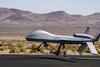
General Atomics on 12 March said it has completed two test flights of a Gray Eagle Extended Range (GE-ER), an improved version of the MQ-1C multi-role, long-endurance uncrewed air vehicle (UAV), controlled via a constellation of small communication satellites.

Known as a Proliferated Low Earth Orbit (PLEO) network, the system uses a large number of small satellites, rather than a smaller group of more-powerful ones, to build a persistent communication web around the globe. The technique was famously pioneered by SpaceX with the Starlink system.

“The PLEO integration and flight testing continue to show that the current GE-ER open architecture is real,” says GA-ASI vice-president of army programmes Don Cattell. “We are practising rapid integration now, which will prove critical to the platform’s survivability and mission success in multi-domain operations.”

The test series is being funded by the US Army, which operates both the MQ-1C and improved GE-25M successor, each capable of carrying a variety of intelligence, surveillance and reconnaissance payloads and up to four Lockheed Martin AGM-114 Hellfire air-to-ground missiles.

With the initial success of the PLEO test flights, the Gray Eagle became the first US Army aircraft to be controlled via the novel approach to satellite communication.

Gray Eagle 25M GE-25M

Source: General Atomics Aeronautical Systems

The use of “Proliferated Low Earth Orbit” satellites will open up “pole-to-pole” operations for remotely piloted aircraft, says manufacturer General Atomics

The service has previously used traditional Geostationary Earth Orbit (GEO) or Low Earth Orbit (LEO) satellite networks to control its large UAVs, including the Gray Eagle.

That is significant, as those systems face limitations in the high-latitude polar regions, where the effectiveness of conventional geostationary satellite communications breaks down. By contrast, PLEO constellations offer more reliable connectivity in those areas.

This month, a senior Royal Canadian Air Force general raised concern about the effectiveness of remotely piloted aircraft operating well above the Arctic Circle.

Major General Chris McKenna says Canada wants its planned fleet of 11 MQ-9B UAVs to be capable of operating over the North Pole – well north of an earlier limit of roughly 78° north latitude established by General Atomics in a 2021 test event using a conventional satellite network paired with a specially designed data storage system.

“I have landmass to 83 degrees north and contiguous waters to [90],” McKenna said at an Air and Space Forces conference on 4 March, referencing Canada’s high latitude polar territories.

“I think we need to solve that problem,” he added. “We need to be able to surveil there.”

The Arctic Circle lies at roughly 66.5° north latitude.

General Atomics says the PLEO option will offer “pole-to-pole coverage” for maintaining connectivity with remotely piloted aircraft such as the MQ-9B and GE-25M.

The company’s initial PLEO testing focused on flight-critical operations, including core aircraft control functions and sensor and communications systems. Future tests are being planned to evaluate operations across the full flight regime, the company says.

The Arctic region is expected to be a major theatre in the new era of so-called “great power competition” between the USA, Russia and China, which are seeking to control natural resources, sea lanes and air approaches at the top of the world.

Traditional US allies in the Arctic like Canada, Norway and Denmark are also being pushed to shore up their interests in the high north, as the actions of the Trump Administration increasingly upend longstanding trans-Atlantic ties that have underpinned security in Europe and North America for 80 years.