











Airbus delivered 793 commercial aircraft last year, just above its target of 790 – although this had been a downward revision of its original aim of 820.
The airframer took gross orders for exactly 1,000 aircraft, with a net figure of 889.
Airbus managed to hand over 136 aircraft in December, its newly-released full-year backlog data shows.
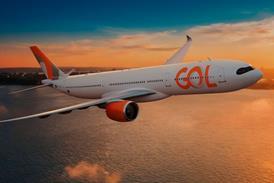
Its overall delivery total for the year comprised 700 single-aisle models – 607 A320neo-family jets and 93 A220s – plus 57 A350s and 36 A330s.
These deliveries exceeded the 766 achieved in 2024, but remained behind the 831 figure of 2018 and the level of 863 met in 2019.
Airbus commercial aircraft chief executive Christian Scherer, speaking on 12 January, said the airframer’s ramp-up trajectory ”continues to move in the right direction”.
While a shortage of engines held up deliveries around the middle of the year, and left the delivery profile heavily backloaded, Scherer insists the engine volume was not the “limiting factor” by the end of the year.
He states that a “quality deviation” on a number of forward fuselage panels forced the downward revision of the delivery target.
“Had we not had [the panel problem] we’d have delivered about 820 aircraft,” he says.
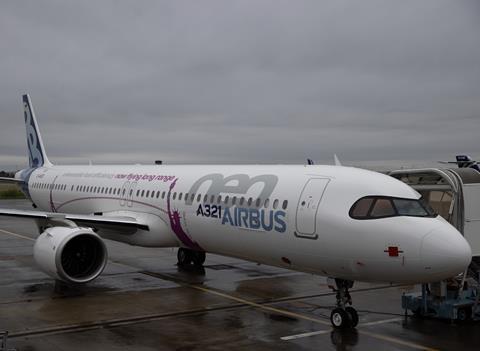
Airbus’s firmed agreements during December included 36 A350s, among them 20 -900s for Spanish carrier Air Europa, six for Ethiopian Airlines, and five -1000s for China Airlines.
Undisclosed customers signed for five A350-900s and four A330-900s.
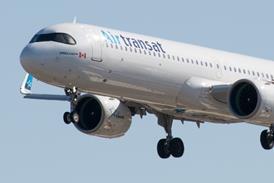
Air China’s order for 60 A321neos led the month’s single-aisle agreements, while Hong Kong lessor CALC is taking 30 A320neos.
Qantas firmed 20 A321neos while four undisclosed customers signed for 42 A320neo-family jets – one of which is taking 35. A further undisclosed customer ordered nine A220-300s.
Airbus also revealed American Airlines as the carrier behind four separate undisclosed orders last year for a total of eight A321neos.
Its backlog at the end of 2025 stood at 8,754 aircraft including 1,124 widebody models.