












The Federal Aviation Administration’s failure to approve Boeing’s next round of 777-9 certification flight testing prompted the company’s decision to again push back the jet’s expected introduction.
The manufacturer said on 29 October it now anticipates the long-delayed 777-9 will enter service in 2027, revised from its earlier 2026 plan.
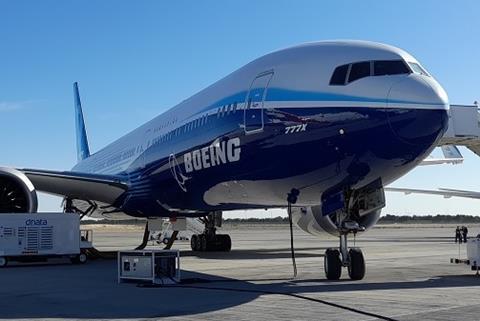
During the company’s third-quarter earnings call, Boeing chief financial officer Jay Malave said Boeing previously received FAA authorisation to begin what was a second phase of flight testing in early 2025.
Boeing had “anticipated” that the FAA would also by now have granted “authorisation to start the next major phase of certification flight testing in the third quarter” but that never happened.
“This authorisation has been delayed as Boeing and the FAA work through the supporting analysis that enables the next phase of certification flight testing,” Malave says.
“We have shifted our flight-test and production schedules to reflect these learnings. We now expect the next major phase to start later this year, or early 2026.”
Boeing chief executive Kelly Ortberg stresses that no “new issues” involving the 777-9 or its GE Aerospace GE9X turbofans have arisen.
The delays are linked to the FAA’s approval of the 777-9’s Type Inspection Authorization (TIA), a document that confirms an aircraft is expected to meet certification standards and allows flight tests for certification credit.
The FAA historically approves Boeing TIAs in their entirety.
But for the 777-9, the FAA, which has increased its oversight following the 737 Max disasters and Boeing’s subsequent quality problems, has adopted an “incremental TIA process ”, approving only portions at a time, says Ortberg.
“We very much underestimated how much work it was going to take for us to get the TIA approvals and for the FAA to have the opportunity to review all the data submissions.”
Though Boeing has completed more than 4,000h of 777-9 flight testing – “more than double a typical flight-test programme” – those hours cannot all be credited to the certification programme, the CEO adds.
On the bright side, all that flight time should help Boeing’s 777-9 certification flight testing, once fully approved, to proceed “relatively quickly”.
Boeing estimates the fresh delay will add $4.9 billion to the cost of the entire 777X programme. It reported that amount as a non-cash reach-forward loss during the third quarter, driving the company to a total $5.3 billion loss for the period.
“The charge amount includes additional customer concessions, the cost of incremental rework on built aircraft, learning-curve adjustments and the carrying cost of production operations spread out over a longer period of time,” says CFO Malave.
Boeing has taken some $15 billion in forward losses against the 777X programme since 2020.