













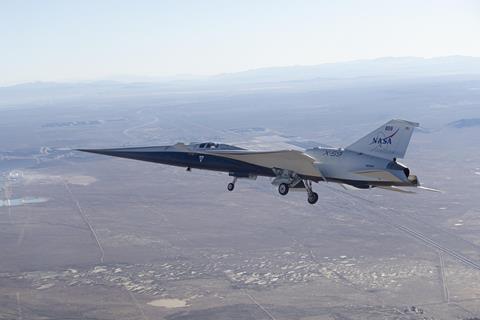
Following its first flight last October, NASA’s X-59 supersonic demonstrator now sits partially disassembled at the agency’s Armstrong Flight Research Center in the California desert.
There, workers have stripped dozens of fuselage panels from the needle-nosed test aircraft so they can complete multiple inspections prior to resuming, as early as this spring, a planned three-phase flight-test programme.
That is according to NASA Low-Boom Flight Demonstrator project manager Catherine Bahm, who describes the programme as on track and calls the 28 October first flight “about as good as you could expect”.
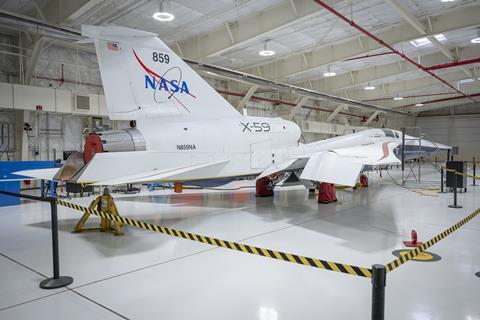
Lockheed Martin, working with NASA, developed the X-59 Quiet Supersonic Technology (Quesst) demonstrator at its Skunk Works site adjacent to the US Air Force Plant 42 airport in Palmdale, California.
For the maiden flight, X-59 took off from Plant 42 and flew for 67min before landing at nearby Edwards AFB, home to NASA’s Armstrong centre, where X-59 is now based.
STRIP DOWN
“We have been doing significant inspections that were required after [the] first flight, which included things like removing the… lower empennage” beneath the aircraft’s single engine, Bahm says.
Workers must also remove the engine – a 22,000lb-thrust (98kN) GE Aerospace F414-GE-10 – to allow for GE-required post-flight analyses that include borescope inspections.
The NASA-Lockheed team are also using down time to complete previously deferred tasks that include removing sensors behind the engine used during ground tests that are no longer needed, Bahm says. “Because of all the inspections and deferred work, we have about 75 or so panels off the aircraft right now.”
The team developed X-59 to demonstrate supersonic jets need not produce massively disruptive sonic booms. NASA expects X-59 to produce a “thump” (like a “car door slamming nearby”) thanks to features including a slender fuselage, a top-of-fuselage-mounted engine, and a “deck” under the engine nozzle affecting how shock waves merge.
It hopes X-59’s performance will persuade the Federal Aviation Administration to ease its overland civilian supersonic flight ban, advancing a new era of supersonic passenger travel. Several private companies are also pursuing supersonic civilian ambitions, including aircraft developer Boom Supersonic. The viability of such efforts remains unclear due to cost, complexity and uncertain market demand.
X-59’s first flight came several years behind schedule – at one point, NASA aimed to complete the milestone in 2021. Delays stemmed from the Covid-19 pandemic and technical hurdles including a flight-control problem discovered in 2023 related to aero-servo elasticity – the interaction between flexible aircraft structures, aerodynamic forces and control systems.
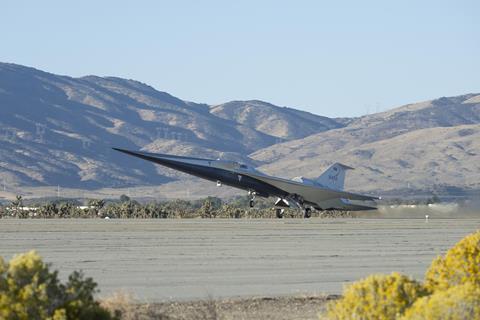
The same features intended to soften X-59’s boom – its pencil-like fuselage – leave it inherently unstable, NASA officials have said. To provide stability, Lockheed gave X-59 a full-authority digital flight-control system that makes continual adjustments based on feedback from sensors.
“It’s a supersonic aircraft, but it’s not a highly manoeuvrable aircraft,” Bahm says. Engineers specifically designed X-59 to perform a singular mission: flying “flat and level” at Mach 1.4 and at 55,000ft.
During the first flight, NASA test pilot Nils Larson flew X-59 to only about 200kt (370km/h) and 12,000ft. “Our test pilot said [the] first flight was boring,” says Bahm, adding that the sortie went near perfectly.
That is not to say there were no hiccups.
Upon landing, the jet’s flight control system failed to immediately transition from air to ground mode, likely due to a “very soft” landing not properly registered by a system composed of a weight-on-wheels switch and associated timer. The team will address that problem with software updates prior to X-59’s second flight, Bahm says. “If you watch the videos of the landing, you can see [X-59] really kind of hovers a little bit and then lands… It didn’t make it unsafe.”
Additionally, a faulty connection during the flight prompted an oxygen sensor to issue erroneous warnings – an issue Bahm describes as little more than a “nuisance”.
STABILITY FOCUS
The first flight allowed NASA and Lockheed to evaluate all major systems. But they focused particularly on X-59’s flight control system, flying qualities and structural dynamics. They completed three “integrated test blocks” – evaluations involving a “combination of flight control system manoeuvres and structural testing”, Bahm says. They flew each test block at 12,000ft but at different speeds.
“We do still have some areas of the flight-test envelope where we have questions about the robustness of the control system and the interaction with the structure, potentially in some regions… of the flight envelope,” she adds.
Once post-flight inspections are complete, the team will rebuild X-59 and then “regress the individual systems that we’ve tested or modified, and then regress the whole aircraft” – requiring another engine run, Bahm says. She expects X-59 will be airborne again in “early spring”.
The first flight-test phase will last roughly one year and involve envelope expansion, with the team working toward flying at Mach 1.4 and 55,000ft, Bahm says. She declines to estimate how many test flights the team might complete but says each flight will last 1-1.5h.
After phase one, NASA plans to take ownership of X-59 from Lockheed before kicking off the second flight-test phase, expected to last six to nine months and involve “acoustic validation” – meaning mapping out X-59’s pressure signature and confirming it meets expectations.
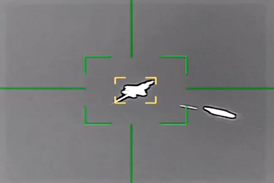
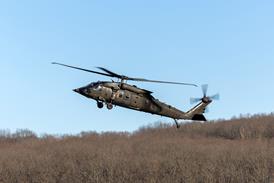
NASA will use ground microphones to collect pressure data and press two other NASA aircraft into service on X-59’s behalf, including a Boeing F-15 fitted with a pressure-sensing probe.
The team plans to fly that jet three body lengths behind X-59, where it will penetrate the shock wave and collect “near field” – meaning close – pressure data. NASA is now validating the F-15’s probe.
The team intends to collect “far-field” pressure data using a TG-14 powered glider fitted with a wing-mounted microphone. The TG-14 – a Brazilian-made Aeromot AMT-200 – will fly much lower, only slightly higher than the turbulence boundary layer, says Bahm.
Finally, in the third flight-test phase, NASA will conduct a series of “community response” missions, flying X-59 over cities and towns and then surveying the public to gauge how people perceive X-59’s sonic noise.
“The first flight was really the first step, the first chapter in that book of us all getting back to supersonic flight,” says Bahm.