












NASA and partner Lockheed Martin have made good on their plan to have the X-59 supersonic demonstrator airborne before year-end.
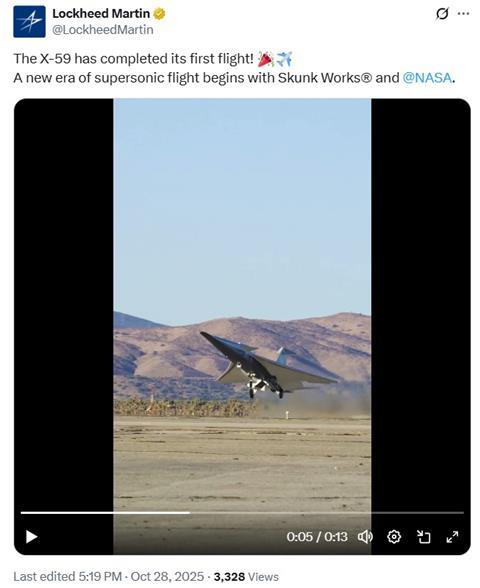
The jet, commissioned by NASA to test design features intended to produce a much quieter sonic boom, took off on 28 October from Palmdale in California’s Mojave Desert, Lockheed Martin says.
The aircraft landed at nearby Edwards AFB.
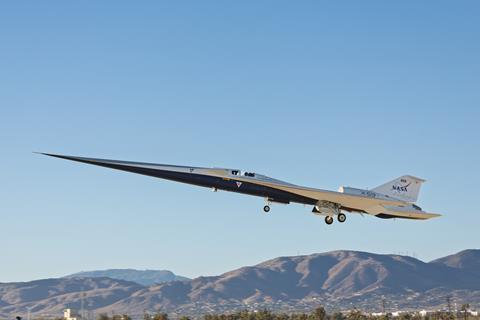
“The X-59 performed exactly as planned, verifying initial flying qualities and air data performance on the way to a safe landing at its new home,” Lockheed says.
Flight tracking site Flightradar24.com shows that the jet took off from Palmdale Regional airport at 08:13 local time, then flew north and circled Edwards numerous times before landing. It was airborne for 1h 7min.
The X-59 is powered by a single 22,000lb-thrust (98kN) GE Aerospace F414-GE-100 turbine. It has fly-by-wire controls and is expected to hit speeds of about Mach 1.4.
Lockheed Martin’s Skunk Works division developed X-59 under NASA’s Low-Boom Flight Demonstrator programme, an effort to develop a “quiet” supersonic aircraft. NASA intends to measure the jet’s noise signature during a series of “community” flights, with the goal of collecting data the Federal Aviation Administration needs to eliminate its overland civilian supersonic flight ban.
In September, NASA said it expected X-59 would get off the ground for the first time before year-end. The timeline had, however, been delayed several times prior.
“We are thrilled to achieve the first flight of the X-59,” says Lockheed’s Skunk Works vice-president and general manager OJ Sanchez. “This aircraft is a testament to the innovation and expertise of our joint team, and we are proud to be at the forefront of quiet supersonic technology development.”
NASA acting administrator Sean Duffy calls X-59 “a symbol of American ingenuity”.
“This work sustains America’s place as the leader in aviation and has the potential to change the way the public flies,” Duffy adds.
Skunk Works is leading the initial flight-test programme and, working with NASA, will “expand X-59’s flight envelope over the coming months”, the company says.
“Part of this test journey will include the X-59’s first supersonic flights, where the aircraft will achieve the optimal speed and altitude for a quiet boom,” Lockheed adds.
NASA did not immediately respond to a request for more information, but the agency has been impacted by the US government’s ongoing shutdown.