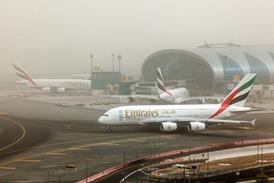














Middle Eastern carrier Emirates is still resisting the Airbus A350-1000, despite suggestions circulating ahead of the Dubai air show that it was lining up an agreement for the twinjet type.
But it has opted for another eight A350-900s, bringing its commitment to the smaller model to 73 – of which 13 have already been delivered.
Emirates has been reluctant to take the larger A350 variant owing to concerns about the performance of its Rolls-Royce Trent XWB-97 engines in the Gulf’s sandy conditions.
Although talks over the A350-1000 have continued, a source familiar with the situation told FlightGlobal, as the Dubai show opened, that any A350 announcement was less likely to involve a -1000 deal but rather a -900 top-up.
Emirates expects its additional A350-900s to be delivered in 2031. This timeframe would allow a potential conversion to the -1000.
President Tim Clark has previously stated that the -1000 would “easily” fit into the Emirates fleet, warming to the aircraft despite early dissatisfaction with a -1000 design revamp that prompted cancellation of a deal for 70 A350s in 2014.
Although Rolls-Royce lost out with the cancellation, it was buoyed by Emirates’ subsequent Trent engine selection to power a new batch of A380s. And despite early reservations about the twinjet’s engines, Emirates put its faith in the Trent XWB-84 when it revisited the A350 – ultimately ordering 65 of the -900 – after the A380 programme ended.
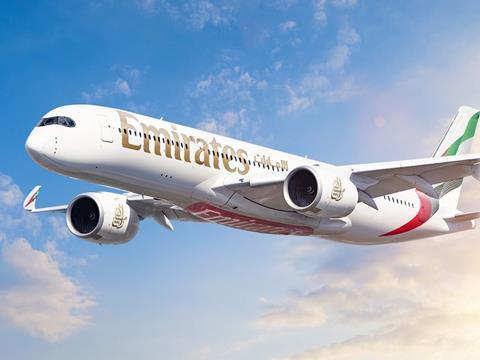
Clark’s verdict on the XWB-84 has been positive, and Rolls-Royce’s senior customer vice-president for the Middle East, Omar Ali Adib, says the $3.4 billion top-up order for eight -900s is a “testament to the confidence” in its engine.
“We extend our gratitude to Emirates for their continued trust in Rolls-Royce,” he adds.
Emirates Group chief Sheikh Ahmed bin Saeed Al Maktoum says the A350-900, which has been in service with the carrier for a year, has “given us welcome additional capacity”.
The carrier is a prominent customer for the Boeing 777X but continuing delays in certification – and the termination of the A380 programme – have left Emirates with few high-capacity alternatives to feed its expansion strategy.
Clark remains critical of the XWB-97 for the A350-1000, arguing that it is not sufficiently robust. Rolls-Royce has been working to overcome this obstacle, vowing to improve time-on-wing performance of the engine in abrasive conditions, with a series of measures which will be fully implemented from 2028.
Despite the 777X hold-up, Emirates has stuck with the Boeing twinjet, increasing its order by 65 aircraft during the Dubai show – and publicly encouraging the airframer to work on a variant larger than the 777-9.