












Japan Airlines Group is mulling “successor aircraft types” for its regional aircraft fleet, as it looks to simplify its fleet structure for the long term.
In its annual report released 1 October, the carrier says it will be “keeping an eye on future demand trends” to decide what would replace its regional fleet in the future.
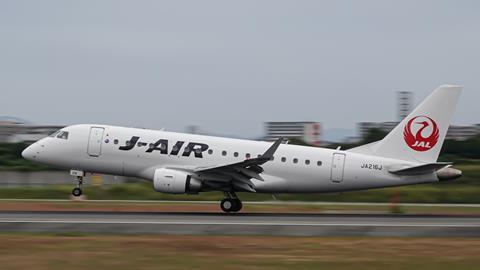
The airline operates a mix of turboprops and Embraer jets on its regional network. It has 32 first-generation E-Jets, as well as 13 ATR 42s, a pair of ATR 72s and five De Havilland Canada Dash 80-400s.
JAL does not state whether it was looking at a single fleet type to replace the entire regional fleet.
Earlier in the year, compatriot All Nippon Airways disclosed orders for 15 Embraer’s 190-E2 aircraft, which will replace its larger aircraft on domestic routes as Japan faces a shrinking population.
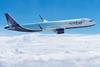
In a similar vein, JAL appears to be shifting towards down-gauging its domestic fleet. The Oneworld operator in 2024 ordered Airbus A321neos to replace its Boeing 767s operating domestic flights.
It will also take delivery of its first 737 Max 8 from 2026, which will replace its older 737-800s. According to JAL, the new 737s will likely have a lower seat count than the -800s.
By 2030, the airline targets about two-thirds of its domestic fleet to be “small aircraft”– referring to its narrowbody fleet – in order to “match supply and demand and improve profitability”. That figure currently stands at around 58%.
The proportion of domestic “large aircraft” – defined as A350s and 777s – is expected to increase from 19% currently to 24% in 2030, while “mid-sized aircraft” – 787s and 767s – will shrink from 19% to 13%. This is largely in line with the delivery of new A350-900s, as well as the retirement of older 767s.
On the international fleet, JAL also appears to be doing away with narrowbody operations by 2030, in favour or more large and mid-sized jets.
Data from its annual report shows that while small aircraft make up 7% of the international fleet, that figure will disappear by 2030. Large aircraft will make up 39% of the fleet, up from 26% currently, while mid-sized jets will dip from 67% to 61%.
The airline has on order A350-900s for international operations, and is continuing to take delivery of the larger -1000s, which are gradually replacing its 777-300ERs on long-haul operations.