












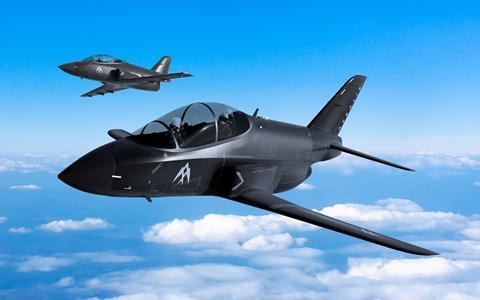
UK aircraft developer Aeralis has signed a strategic agreement with Glasgow Prestwick airport covering the proposed future final assembly of its modular light jet in Scotland.
“Our agreement builds on Prestwick’s strong aviation legacy, as well its excellent local aerospace manufacturing and MRO resources,” says Aeralis chief executive Tristan Crawford. “It provides Aeralis with tremendous operating capability for building, testing and industrialising new aircraft for the UK, Europe and the world.”
“This agreement is the foundation stone that will return Scotland to its deserved place as a first-tier aviation nation,” Prestwick airport chief executive Ian Forgie says of the 6 September pact. “We remain tremendously excited about the opportunities it brings to generate jobs, apprenticeships, investment and innovation,” he adds.
“The parties will now work together to identify and review site facilities, assure the availability of airspace, and engage with local regulatory requirements. They will also seek to work with local aerospace companies and develop training and course design opportunities with Ayrshire College,” the start-up airframer says.
Aeralis had in early July announced the Prestwick site as its preferred final assembly location for a future aircraft family. It plans to perform manufacturing of the platform’s common core fuselage in Hampshire, England.
Meanwhile, the company used the DSEI exhibition in London to announce a cooperation agreement with Pennant International.
“Pennant’s proven expertise in supporting the design, operation, maintenance, and training of complex assets will play a key role in enhancing the operational and maintenance efficiency of the Aeralis platform,” it said on 9 September.
Their pact includes the provision of programme analysis, “the development of digital training and maintenance solutions… and joint exploration of data-driven support strategies”.
Aeralis is pitching its jet trainer design at requirements including a need to replace the BAE Systems Hawk T1s and T2s operated by the UK Royal Air Force. It also has identified potential near-term requirements as existing in France and Qatar.