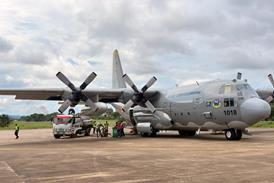














Airbus Defence & Space is confident that it is a matter of when and not if it will make a marquee sale of its A400M Atlas to the Royal Saudi Air Force (RSAF).
The European-built airlifter’s ability to operate in hot and sandy conditions and a pending increase in maximum payload capacity will be central to it securing a deal, says A400M programme manager Gerd Weber.
Speaking at the World Defense Show (WDS) near Riyadh on 9 February, Weber said the step – which will increase the tactical transport’s approved cargo limit to 40t, from 37t presently – sets the A400M apart from potential competitors.
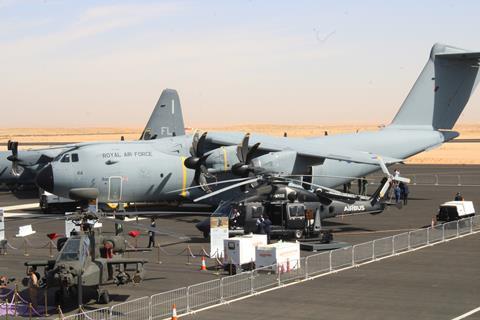
Crucially, the increase will enable the aircraft to transport heavy equipment including tanks and elements of the Patriot air-defence missile system for the RSAF.
“One of the hard requirements is the payload – there is not much competition that can carry 40t,” Weber notes. In fact, the A400M is the only such candidate, with the rival Lockheed Martin C-130J and Embraer Defense & Security C-390 having lower cargo limits.
Officially named the ‘super logistic high weight’ variant, the enhancement will be achieved via software updates, with no hardware changes required. Airbus test pilot Jon Taylor says loads analysis work is ongoing, with this indicating a slight reduction in g-loading limits at increased capacity.
“It is in development, and we want it to be ready for 2028-2029,” Weber states of the enhancement.
Another unique configuration item on offer for Riyadh is the ability to carry an ISO container-type VIP cabin module.
“This is a game-changing asset for the Middle East region – and it is complementary to the A330 MRTT [multi-role tanker transport],” Weber notes. “We are convinced it is a good offering and the capability needed for the Kingdom of Saudi Arabia.”
The RSAF currently flies six of the Airbus-supplied tankers, with another four on order.
On the opening day of the 8-12 February event, Airbus signed a memorandum of understanding with Saudi Arabian Military Industries (SAMI) related to the A330 MRTT and future opportunities.
“This is the foundation on which we will build,” Weber says. “For the A400M we would bring some specific elements to the country, not only MRO, but also in parts of the primary production system for the aircraft.”
In July 2024, the airframer announced a pact with SAMI covering their establishment of a joint venture (JV) company named SAAMS, to “transfer technology and knowhow of the RSAF A330 MRTT to local companies”, supporting Riyadh’s Vision 2030 initiative.
Weber says the JV is “on a growth path, and is really developing very well”.
“We can go high, fast and far,” Weber says of the A400M, with the type able to achieve Mach 0.72 at 40,000ft. And for operations in the Middle East, Airbus also touts the turboprop’s ability to use short and unpaved runways – it can deliver a 25t payload onto a sand strip only 750m (2,460ft) long and take off again within 950m with enough fuel to cover a return leg of 500nm (925km).
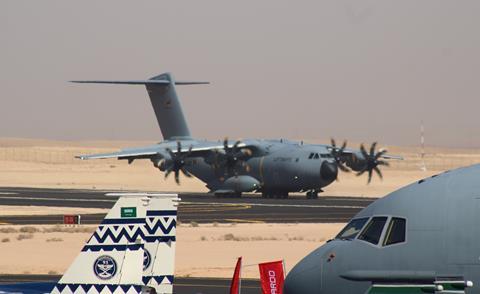
There are two A400Ms present at this year’s WDS event: a UK Royal Air Force example which is on show in the static display, and a German air force Atlas which touched down on 9 February.
Berlin has the largest active fleet of the four-engined type, with its Luftwaffe having just taken delivery of its 52nd aircraft, from an eventual total of 53.
Airbus Defence & Space has now delivered 137 of the aircraft to 10 nations, against a current order total of 178. Shipments last year included first examples for new export operators Indonesia and Kazakhstan.
Weber says that in addition to the current campaign in Saudi Arabia, other export opportunities exist in the United Arab Emirates, along with Japan and Poland.
“Also, the core [partner] nations are starting to look at their fleet size requirements,” he adds. The A400M was developed for the air forces of Belgium, France, Germany, Luxembourg, Spain, Turkey and the UK.
Although the Atlas has been in operational use for over 10 years now, with a combined total of more than 250,000 flight hours logged by operators, Weber notes that it is “still a reasonable youngster”.
Meanwhile, Airbus’s defence unit is advancing work on a study project which is assessing the A400M’s potential to act as a “mothership” capable of deploying uncrewed aerial systems (UAS) and cruise missiles in-flight.
A so-called “warehousing” installation is already in ground testing, with the roll-on, roll-off design able to house up to 50 UAS or a reduced number of remote carriers or deep strike weapons. That could include between nine and 12 Taurus air-launched cruise missiles, the company says.
“We have a ground demonstrator for the magazine, and aim to fly with it in 2029,” Weber says.
The company also is exploring the possibility of adapting the transport for new roles such as intelligence, surveillance and reconnaissance and stand-in jamming support.