














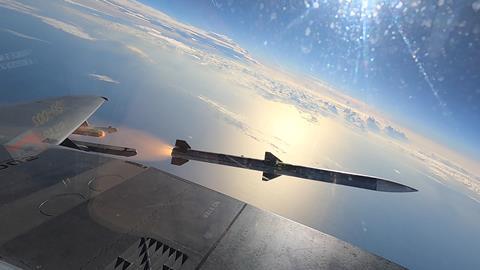
Anduril and Raytheon have conducted a ground test of an advanced solid rocket motor that could lead to a performance boost for air-to-air weapons.
The work involved a static fire test of a rocket motor using a Highly Loaded Grain (HLG) configuration, which the companies hailed as a “major advancement in propulsion technology”.
The two companies worked with the Air Force Research Laboratory Munitions Directorate for the test.
The HLG was designed by Anduril and used technology from Naval Air Weapons Station China Lake.
“The design enables significantly greater volumes of energetic propellant, delivering increased specific impulse and enhanced motor performance. These improvements translate directly into extended range and greater tactical advantage for US and allied warfighters.”
The companies provided few details, including the exact test date and how long the HLG test lasted. No details were provided about specific weapons that could benefit from HLG.
Nonetheless, improving the performance of air-to-air weapons is a clear priority for the USA and its allies given China’s rapid defence build-up. Beijing has invested heavily in high-performance beyond-visual-range air-to-air missiles such as the PL-15, PL-17, and a developmental ramjet-powered weapon tentatively designated PL-XX.
These weapons feature ranges from 107-162nm (200-300km) and equip advanced types such as the Chengdu J-20, the new Shenyang J-35/J-35A, as well China’s fourth-generation jets.
Raytheon, for its part, is a critical supplier of air-to-air weapons, producing the AIM-9X infrared homing missile, the AIM-120 Advanced Medium-Range Air-To-Air Missile, and the AIM-174B, an air-launched derivative of the SM-6 ship-based missile.
Giving existing weapons additional range through improved propellant is preferable to increasing their mass, as advanced fighters such as the Lockheed Martin F-35 and F-22 have limitations owing to the fixed size of their internal weapons bays. The developmental Boeing F-47 is all but certain to feature weapons bays for the internal carriage of weapons, as are in-development unmanned collaborative combat aircraft.
“This test demonstrates more than just a technical achievement,” says Colin Whelan, president of Advanced Technology at Raytheon.
“It’s about building a more robust and adaptable supply base for solid rocket motors that can rapidly respond to emerging national security needs.”