














The Japan Air Self-Defense Force (JASDF) has posted images of the developmental Kawasaki EC-2 electronic warfare aircraft, as it considers options for remaining C-2 production slots.
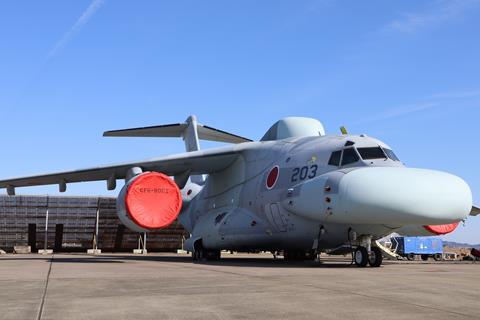
The JASDF Air Development and Test Command posted images of the EC-2 on 12 March – the aircraft was converted from the first C-2 delivered.
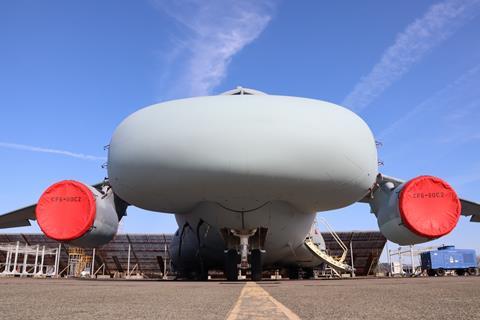
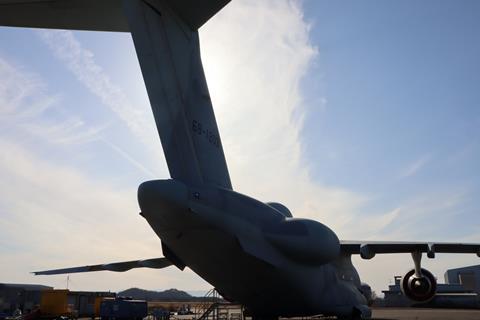
The aircraft was photographed at Gifu Airbase. Visually it features a distinct platypus nose, lateral fairings along either side of the rear fuselage, and a single dorsal hump just over the wings.
It is probable that the large nose contains radar jamming antennas for use as the jet flies towards a target.
The lateral fairings likely contain side-looking electronic countermeasures and electronic support measures sensors. These allow the aircraft to detect hostile radar signals and jam them.
The dorsal hump likely houses an array that can jam enemy data links and satellite communications.
Japan’s Acquisition, Technology and Logistics Agency (ATLA) says that development of the EC-2 will be completed in fiscal year 2026, which ends on 31 March 2027, with the aircraft entering service in fiscal year 2027.
After service entry the aircraft, powered by a pair of GE Aerospace CF6 engines, will be assigned to the Electronic Warfare Operations Group at Iruma air base.
ATLA adds that the number of aircraft to be acquired is “currently under consideration.” Japan operated a single EC-1 standoff jammer from 1986 to 2025, with its retirement creating an operational gap. Japanese planning documents have suggested that up to four EC-2s could be acquired.
So far, the JASDF has received 18 C-2s, but the first example was converted to the EC-2, and another to the RC-2 electronic intelligence standard. This leaves 16 aircraft in the baseline transport role.
With four C-2 production slots remaining, Tokyo is deliberating between the mix of C-2s and EC-2s.
Transitioning from a single EC-1 to a fleet of four EC-2s would mark a major shift to a permanent electronic attack capability for the JASDF.
FlightGlobal also asked ATLA about reports that Japan may obtain used Boeing C-17s or Airbus Defence & Space A400Ms, as well as plans for its aging Lockheed Martin C-130H fleet.
In response, it stated that “nothing that has been decided at this time.”
ATLA also touched on an effort during FY2023-24 where a JASDF C-2 tested the US Air Force’s Rapid Dragon system, where multiple long-range cruise missiles can be launched from a canister dropped from a transport’s rear ramp.
The system promises to give transport aircraft a secondary strike capability.
“Based on the results of the research and studies, the introduction of such equipment is under consideration by the JASDF, and nothing has been decided at this time,” says ATLA.