

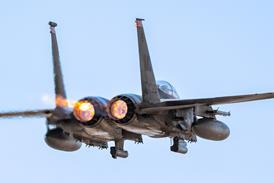














Raytheon has introduced an updated version if its APG-82 radar that incorporates gallium nitride (GaN) to boost effectiveness, as its electronic warfare offering for the Boeing F/A-18E/F Super Hornet passes a key milestone.
The APG-82(V)X is better at detecting targets, tracking engagements, and features “multi-function fire control and electronic warfare capabilities,” says the company.
The radar is in development in El Segundo, California, and will be produced in Forest, Mississippi.
“The enhanced capability of this next-generation radar enables aircrew to detect and engage threats at longer ranges than ever before, providing a crucial first-look, first-shoot advantage,” says Dan Theisen, president of Advanced Products and Solutions at Raytheon.
“As the threat environment evolves, this new radar will ensure faster decision making and superior situational awareness in contested environments.”
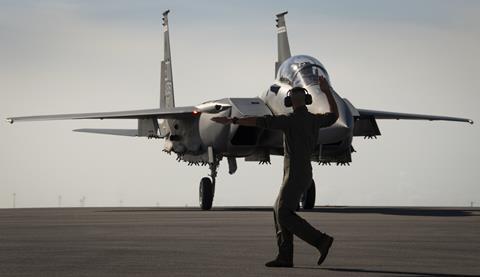
The APG-82(V)1 is the active electronically scanned array (AESA) radar that equips the Boeing F-15EX fighter that is entering service with the US Air Force.
At the Paris air show in June, a Raytheon executive said that radar antennas based on GaN are superior to earlier radars that use gallium arsenide. The use of GaN allows “more power out of the front end” without major changes to an aircraft, he said.
In its statement announcing the APG-82(V)X, Raytheon did not mention customers for the system. One application is likely to be the F-15EX, as well as the global F-15 upgrade market.
Separately, Raytheon says that its prototype of the Advanced Electronic Warfare (ADVEW) system for the US Navy’s F/A-18E/F Super Hornet has passed a key review milestone, validating progress with the system’s software and integration with flight representative hardware.
“Our ADVEW prototype continues to showcase significant progress in both hardware and software that will improve the aircraft’s ability to detect and counter electronic threats,” says Theisen.
“We are on track with our fast-paced schedule and will continue developing the system to meet all necessary requirements on the US Navy’s (USN’s) accelerated fielding timeline.”
L3Harris has a rival offering for the USN’s ADVEW requirement.
Despite the advent of the Lockheed Martin F-35C, the Super Hornet will remain a key element of aircraft carrier air wings beyond the 2030s.
The fighter’s updated Block III configuration is in operational service, offering better sensors as well as improved data processing and transmission.