











At the recent Seoul ADEX show, Leonardo outlined plans to deepen its partnership with Hanwha Systems through locally produced active electronically scanned array (AESA) radars derived from its Grifo E line.
The two companies have collaborated for years, with the Italian firm supporting its Korean partner in developing an AESA radar for the Korea Aerospace Industries (KAI) KF-21 fighter.

Leonardo helped develop radar modes and assisted with flight testing and software, says Luca Picollo, who leads the airborne business of Leonardo Electronics.
“We had a phase for development, we had a phase for the prototype, and we are already going to series production,” says Picollo.
South Korea’s indigenous AESA radar was among the most challenging elements of the KF-21 programme. In August, Hanwha rolled out the first mass-produced radar for the KF-21, a type that will enter service in late 2026.
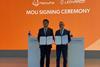
Leonardo also assisted Hanwha in developing the KF-21’s infrared search and track (IRST) sensor. At the show, the two companies signed an agreement to explore opportunities in the electro-optical and infrared sensor space.
Leonardo is also working with Hanwha on the Grifo EK, a South Korean-produced radar based on the Grifo E, itself an evolution of the mechanically-scanned Grifo M.
“We are providing the processing and software, and they are providing the antenna,” says Picollo. “[Hanwha] has their own technology for this kind of antenna. We are integrating this solution for platforms that can be Korean or for export.”
He adds that the Grifo E has flown on a test aircraft and that all modes have been tested, with the radar performing as expected. “The development phase has very good progress. We are now working on the industrialisation of the production line to allow us to produce the right quantity at the right time.”
The main platform for the Grifo E will be the Leonardo M-346 advanced jet trainer, as well as unmanned aircraft produced by Turkish company Baykar. In June, Baykar and Leonardo formalised their LBA Systems joint venture, which will see the Italian company’s sensors and other equipment paired with Baykar’s uncrewed aerial vehicles (UAVs).
One platform that will feature the Grifo E is the twin-engined Akinci UAV.
![[Photo4] AESA radar mounted on a platform simulator for ground-based functional and performance testing before flight trials](https://d3lcr32v2pp4l1.cloudfront.net/Pictures/480xany/5/8/9/113589_photo4aesaradarmountedonaplatformsimulatorforgroundbasedfunctionalandperformancetestingbeforeflighttrials_783684.jpg)
The Grifo E also has potential applications with “loyal wingman” aircraft being developed under the Global Combat Air Programme (GCAP) between Italy, Japan, and the UK. Other markets include US companies developing unmanned combat aircraft, and operators of jets used in the aggressor training role, such as Lockheed Martin F-16s.
The distinguishing feature of the Grifo EK produced with Hanwha will be its antenna, with the radar pitched for use aboard South Korean platforms for both export and domestic markets. Picollo sees the FA-50 light combat aircraft as a key opportunity. There is a clear market for AESA-equipped FA-50s, with KAI integrating Raytheon’s PhantomStrike AESA on aircraft ordered by Malaysia, the Philippines and Poland.
The appeal of the Grifo EK lies in its local production. “A Korean platform with a Korean sensor,” says Picollo.
This could be especially attractive should the Republic of Korea Air Force decide to upgrade the radar on its large FA-50 fleet.
Picollo says he is impressed with Hanwha’s technical capabilities. “They have a very good technical level. From a marketing point of view, they are aggressive, and also very good with the technical maturity of their projects. For us, it’s good to expand this collaboration.”