
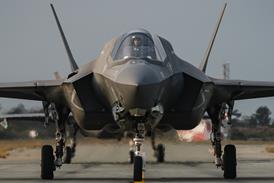












In a major shake-up of the USA’s Middle East policy, President Donald Trump says he will approve the sale of Lockheed Martin F-35 stealth fighters to Saudi Arabia.
Riyadh has sought to purchase F-35s for years and the granting of approval for such a deal has been under active deliberation in Washington in recent weeks, as Trump prepares to meet with Saudi crown prince Mohammed bin Salman in Washington this week.
Speaking at the White House on 17 November, Trump said he has decided to move forward with the deal.
“We will be doing that,” Trump said from the Oval Office. “We will be selling F-35s.”
The US president did not offer specifics about the terms for a sale, including the number of aircraft covered. But he did praise Saudi Arabia as being a “great ally” to the USA.
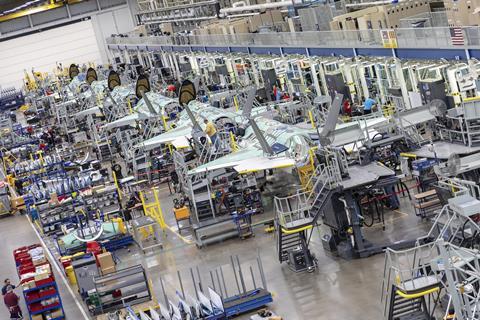
Reuters has previously reported that Riyadh is seeking 48 of the single-engined strike fighters, a package that would be worth roughly $4 billion using previous-year pricing for the conventional take-off and landing F-35A.
If it ultimately goes through, the deal would make Saudi Arabia the 21st global operator of the US-made stealth fighter.
Currently, Israel is the only Middle East operator of the USA’s premier fifth-generation fighter – with the local-specific F-35I configuration.
Washington has previously declined to approve F-35 sale requests from other governments in the region, with an eye toward maintaining the capability edge enjoyed by ally Israel.
Qatar submitted a formal request to purchase F-35s in 2020 during the waning months of the first Trump Administration. That bid was eventually rejected by the successor administration of President Joe Biden.
A separate deal to sell F-35s to the United Arab Emirates also collapsed during the Biden Administration, in part over concerns about the potential for China to collect technical data on the stealth fighter’s advanced capabilities within the UAE.
Trump had supported selling F-35s to the UAE and the deal likely would have gone through in 2021, had Biden not defeated Trump in the November 2020 presidential election.
The apparent approval for a Saudi purchase is both a continuation of Trump’s previously indicated preferences and potential leverage with Riyadh, whom he has been pushing to establish formal diplomatic relations with Israel.