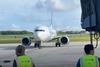











Breeze Airways chief David Neeleman believes the airline’s fleet could grow by several hundred aircraft.
“We think there is enough market for about 400 airplanes, and we only have 50,” he says. “We think there is a lot of leverage there, if you get it right.”
Such a fleet expansion, which Neeleman described briefly in a Bloomberg TV interview on 2 October, would represent major growth from Breeze’s current fleet of about 50 Airbus A220-300s and Embraer E190s.
Operating 400 aircraft would place Breeze firmly in the middle tier of US carriers in terms of fleet size, comparable to Alaska Airlines and JetBlue Airways.
”We’re getting an airplane about every three weeks,” Neeleman says. ”We have on firm order about 90 Airbus A220s, with an option to go to 120.”
Breeze plans to phase out E190 operations and become an-all A220 operator next year. Currently, it still flies about 10 E190s.
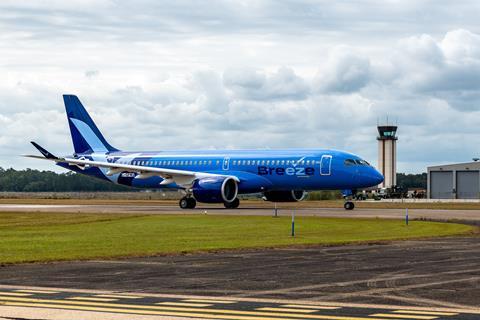
Using smaller aircraft than most competitors, Breeze’s strategy is to target secondary cities and untapped markets in the US, and now near-international destinations in Mexico and the Caribbean.
The Utah-based airline recently secured secured permission from the US Federal Aviation Administration to operate internationally.
“Saturdays are a little bit of a down day for air travel, but being able to take those airplanes and fly to Cancun and Punta Cana and Montego Bay, Jamaica, is going to be a real great asset for us,” Neeleman says.
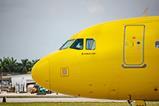
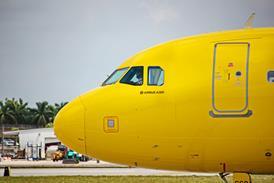
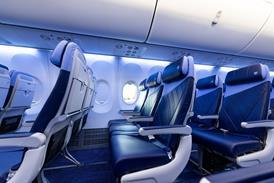
Breeze’s 137-passenger A220-300s allow it to target more niche markets, rather than flying larger narrowbodies into big cities in head-to-head match-ups with major US carriers – a strategy that has proven difficult for A320neo operators such as Spirit Airlines.
“The challenge with Spirit was that their planes got so big, they had to overlay Delta, United, American, and that’s a really tough business to be in because they can just create basic economy and match everything that we’re doing,” he says.
Breeze, rather, seeks city pairs that have no overlapping competition.
Notably, rival start-up carrier Avelo Airlines placed a major order for Embraer E195-E2s, which would represent competition for Breeze in the small-narrowbody market. Avelo chief Andrew Levy describes the E195-E2 as well-suited for smaller markets that major airlines avoid.
Both A220-operator JetBlue and Southwest Airlines, which flies older 737-700s, fly smaller narrowbody jets on US domestic routes.