

















Airbus Helicopters continues to accelerate testing of its new H140 following the light-twin’s launch in March last year, with cold weather trials now under way and a hot-and-high campaign set to kick off in the USA later this year.
“2026 for the H140 is the year of testing,” says programme chief Dirk Petry. “We are in front major campaigns with the prototypes we are also executing off-aircraft tests [to] validate individual components or assemblies.”
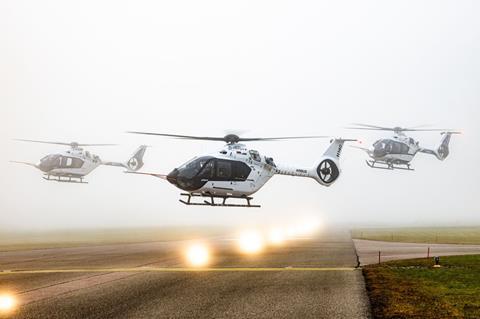
While the programme briefly had three prototypes flying following the roll-out of the third example in December, the first aircraft - PT1 - has now been “decommissioned”, says Petry, briefing journalists at the airframer’s Marignane headquarters in southern France.
“This has now executed its tasks for flight testing. It will not be used for certification flights anymore.”
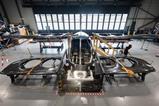
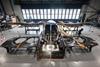
PT1 has been flying since June 2023 in one form or another and served to validate the H140’s basic configuration and aeromechanical architecture.
Aircraft PT2 - the first in a pre-serial configuration - is currently in Norway completing a second phase of winter testing, evaluating the performance its engine air intakes in snowy conditions.
Its move to Norway followed cold-weather trails in Finland where it was exposed to temperatures down to -30°C (-22°F) and below.
Airbus Helicopters had expected to “have colder temperatures” to ensure approval for operations down to -40°C but Petry believes the data gathered “was in line with what we need for entry into service in the EASA region”.
PT2 will remain in Norway until the end of March before returning to its Donauworth home in the south of Germany where it will face a short lay-up prior to it being dispatched to the USA for a hot and high certification campaign. This will begin in the early summer and take place in Leadville, Colorado and “one or two other locations”, he says.
Although the company last summer performed separate hot and high evaluations in Spain and France, respectively, using aircraft PT1, these were purely to validate the aircraft’s performance rather than for certification purposes.
Meanwhile, PT3, what Petry calls “the basic certification aircraft” has “just entered service” flying from Donauworth, where it was built, to calibrate the autopilot system. A more comprehensive flight-test programme will commence later this year.
A fourth prototype, in a full serial configuration, is now in production and will likely fly towards the end of the year. This will be used for “major certification tests under relevant mission conditions”, adds Petry.
PT4 will also be the first of the test fleet produced “in a full serial environment”, rather than in a prototyping shop.
Major component assemblies (MCAs) for the rotorcraft have been received at Donauworth from other Airbus Helicopters facilities and will enter the final assembly process “in the next weeks”.
Additionally, parts for the first serial aircraft are beginning to being built into MCAs, supporting a first flight next year. The airframer will use this asset for certain certification tests and for use as a demonstrator. Parts production for the first customer aircraft is also under way.
Airbus Helicopters has also carried out other related evaluations, including the fuel drop test - dropping a fuselage from a height of 15m (50ft) to check fuel-system integrity in the event of crash.
Certification and service entry are scheduled for 2028 and “the progress last year was fully in line with this service-entry target”, he adds.
Airbus Helicopters has accumulated 61 firm orders for the H140 since its March 2025 launch, with options and other tentative agreements taking the total to more than 100 commitments, says Petry, the majority of which are from the emergency medical services operators.
“It is a major success for us in the segment. It is underlining that the H140 is what the market is seeking.”
Petry, who is also in charge of the H135 - from which the H140 is derived - insists the older platform still has a place in its line-up, pointing to the 45 orders secured by the long-running light-twin last year.
“The H140 is not a replacement for the H135 - it offers more mission flexibility but at a [price and weight] premium.”
Production of both types will take place on a dedicated final assembly line in Donauworth to take advantage of the “commonalities” between the pair. “It is the most efficient set up between production lead times and balancing between the two models.”
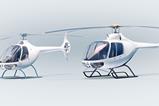
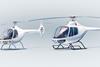
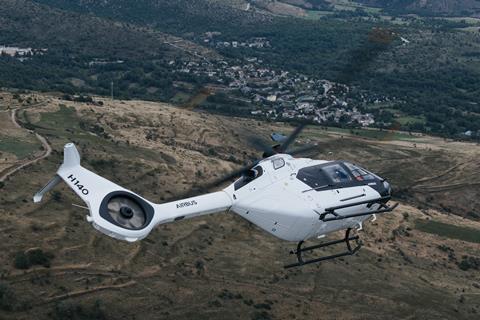
Taking the H135 as its certification baseline, the H140 gains a new five-bladed main rotor, larger cabin, shrouded Fenestron anti-torque rotor a streamlined T-tail, and new 700shp (520kW)-rated Safran Helicopter Engines Arrius 2E powerplants.
Maximum take-off weight will sit at 3,175kg (7,000lb) – the upper limit for the CS-27 small rotorcraft category – against 2,980kg for the H135.