









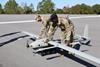

US Army soldiers undergoing instruction in the use of uncrewed systems for aerial reconnaissance will begin operating Edge Autonomy’s VXE30 Stalker this month.
The army on 24 November confirmed that it has begun fielding the Stalker at the service’s main aviation hub in Fort Rucker, Alabama – just a few months after deciding to procure the vertical take-off and landing (VTOL) type.
In August, the army selected the Stalker for the prototype phase of the Long Range Reconnaissance programme meant to improve the identification and tracking of battlefield threats over greater distances.
Instructors at Fort Rucker began training with the Group 2-category Stalker in November ahead of the uncrewed aircraft’s introduction in December to students attending two instructional courses focused on aerial reconnaissance at the tactical level.
That role was previously filled by the Textron RQ-7B Shadow, which the army retired in 2024.
The larger Group 3-class RQ-7B was set to be replaced by a new design under the Future Tactical UAS programme, which the Pentagon cancelled earlier this year as part of a broad shake-up of the army’s aviation strategy.
While the service has not yet formalised long-term plans for new small aerial reconnaissance platforms, the army is moving aggressively to incorporate small drones into its conventional rotary-wing aviation forces.
Efforts along this line include allowing tactical-level commanders to directly purchase their own drones and the testing of so-called Expeditionary Manufacturing Cells – mobile 3D printers that allow tactical-level units to directly produce quadcopter components.
The Army Aviation Center of Excellence says the Stalker was identified as a promising surrogate for training soldiers on the fundamentals of aerial reconnaissance during the Army UAS Summit event in August.
“This is the first time in years that we will be utilising a Group 2, almost Group 3-size UAS in support of an army course at Fort Rucker, since before the Shadow was really employed,” says Major Wolf Amacker, branch chief for UAS and tactics at Aviation Center of Excellence.
The Stalker’s open source configuration was a key factor in the rapid fielding decision, allowing for the incorporation of a range of sensors and payloads into the UAS training.
That includes equipping kinetic munitions via the army’s existing Common Lethality Integration Kit, which accommodates a range of weapon systems, including low-cost 81mm mortar shells.
“It’s a cheaper solution that can be rapidly reproduced,” says Major Rachel Martin, director of both the Air Cavalry Leaders Course and Unmanned Advanced Lethality Course.
“Instead of a Hellfire missile costing $100,000 to $150,000 per round, this solution costs about $800,” she adds. “That disparity is significant, and it reflects lessons from the Ukrainian fight, where cheaper solutions are proving decisive.”
The Stalker offers other significant advantages over the legacy, catapult-launched Shadow, including VTOL capability and reduced acoustic signature.
In forward flight, the VXE30 is “deadly silent”, according to Martin.
“Its reduced visual and acoustic signature makes striking a target at 300ft very likely, something that wasn’t possible with louder systems, like the Shadow.”
The US Marine Corps already operates the Stalker in a frontline role, including at overseas locations around the Indo-Pacific.
In 2022, Lockheed Martin’s Skunk Works unit completed a record-setting 39h, 17min sortie with a modified Stalker example, securing the title of longest ever flight by an aircraft weighing between 5-25kg (11-55lb).
That feat was certified by the World Air Sports Federation (FAI) and remains the current record for flight duration by a multi-rotor UAV (Class U-3), according to the FAI.