















Continuing a recent trend of announcing significant developments in military aviation around the end-of-year, China has revealed the first flight of another experimental uncrewed jet.
This time it is the CH-7 – a tailless, flying-wing type designed and built by the China Academy of Aerospace Aerodynamics (CAAA) for long-range reconnaissance and target identification.
The maiden sortie was reported by the Chinese Communist Party publication the People’s Daily on 15 December. An exact date of the flight was not provided, although Beijing says it took place somewhere in northwest China.
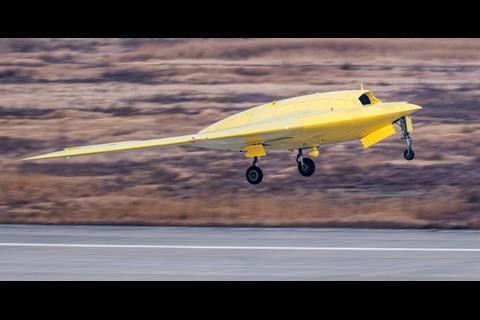
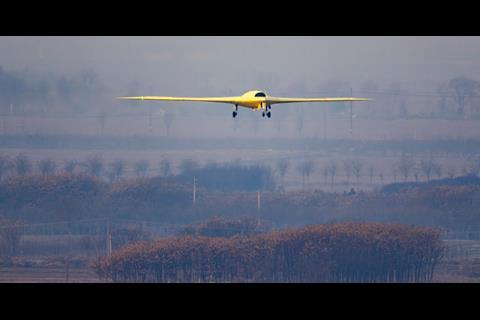
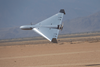
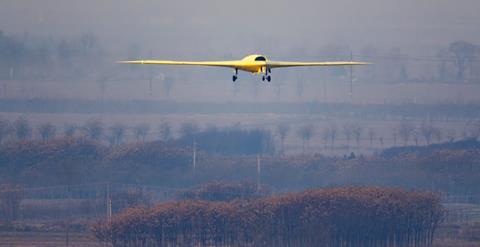
Video footage shows a CH-7 prototype in yellow primer taking off from a tarmac runway, offering clear views of the jet’s engine exhaust and split ailerons embedded in the trailing edge of the wing surface.
The CH-7 can carry “multiple high-performance mission payloads, including visible-light and infrared systems”, according to Beijing. “It is also capable of meeting advanced operational requirements such as ground observation and data support in complex environments.”
Such an aircraft would be useful in supporting the development of so-called “kill chains” or “kill webs”, in which multiple battlefield assets are connected via data link to share target data.
An effective kill web could see an unmanned reconnaissance platform like the CH-7 detect and identify a potential target, such as a ship or aircraft, and then relay that information to a crewed stealth fighter or airborne early warning and control aircraft safely removed from enemy defences.
The target data could then be assessed for action and passed along to yet another asset armed with long-range missiles, which could be another aircraft, a ship or ground-based battery.
China’s reveal of a CH-7 flight came the same week that Beijing announced the inaugural launch of another indigenously developed uncrewed aerial vehicle (UAV) – the Jetank “drone swarm carrier” built by state-owned AVIC.
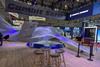
The existence of the CH-7 was previously known, after the uncrewed jet was featured in a static display at the 2024 Zhuhai air show in China.
While the CH-7 was at the time shown alongside an array of small munitions and air-launched UAVs, its true purpose seems more likely to be long-range reconnaissance and targeting.
Images of the type first flight distributed by the CAAA, which is a subsidiary of the China Aerospace Science and Technology Corporation, show that the current design has largely remain unchanged since 2024, although new details are now visible.
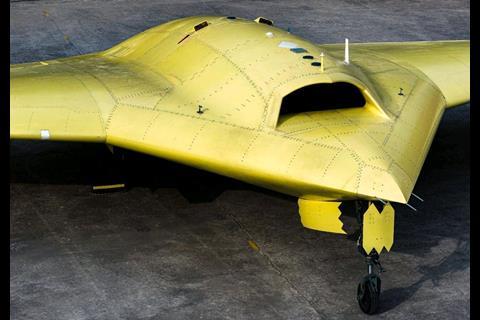
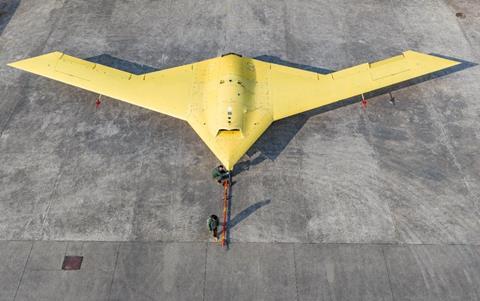
The flight-capable CH-7 prototype features the tailless, blended-wing body fuselage, tricycle landing gear and large, dorsally mounted air intake above the nose section that were all seen at Zhuhai.
However, the video footage and still imagery of the inaugural flight shows even further indicators that the uncrewed jet is designed for stealth applications.
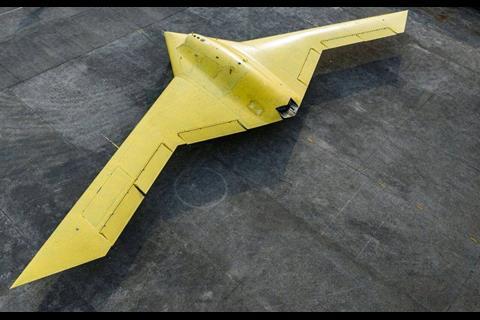
The CH-7 features the radical cranked kite shape that has become associated with the several of the latest low-observable platforms. Additionally, the CH-7’s exhaust nozzle show clear indicators of being designed for a reduced signature.
Visible in the latest imagery, after being obscured from view at Zhuhai, the exhaust of the CH-7’s single engine features what is known as an “aft deck” – a plate located below the nozzle that channels hot exhaust upward.
An aft plate can reduce an aircraft’s thermal signature when viewed from below and can also the lessen the audio signature of a jet engine.
Lockheed Martin’s X-59 supersonic civil demonstrator features an aft deck, which is meant to channel the shockwaves that form when breaking the sound barrier upward, rather than down toward the ground, thus reducing the volume of a sonic boom as heard from below.
Northrop Grumman’s B-2 stealth bomber also features twin aft decks, which are meant to shield the composite airframe and sensitive radar absorbent coating from the heat and vibration generated by the bomber’s four GE Aerospace F118 engines.
Available imagery of the USA’s next-generation B-21 stealth bomber being developed by Northrop indicates that design also features either fully recessed engines or aft decks and the same cranked kite shape.
All of the flying-wing shapes, including the CH-7, feature control surfaces embedded in the trailing edge of the dogtooth wing to enable aerodynamic control without vertical tail fins, which would increase the radar signature.
China has been aggressively pursuing the development of new uncrewed combat jets in recent years, with a particular focus on tailless designs.
A large military parade staged in Beijing this past September featured a number of new UCAVs boasting a range of outer mould shapes, engine configurations and wing structures.
Notably, none of those actually flew during the commemorative event and were instead carried via truck.
Others, such as the Hongdu GJ-11 Sharp Sword, have been documented in flight.
That tailless, flying-wing design was shown flying alongside a Chengdu J-20 fighter and Shenyang J-16D electronic warfare aircraft in footage released by China in November.
The GJ-11 is believed to be a “loyal wingman”-type platform for supporting manned Chinese fighters.
Another tailless UAV, about which even less is known, was filmed in flight earlier this year. Tentatively dubbed the WZ-X, the jet’s high aspect ratio and low-observable shape suggests a high-altitude loitering platform designed for either battlefield targeting or deployment of long-range strike missiles.
Similar to 2025, Beijing also revealed major developments in its military aerospace programmes during the end of last year. December 2024 saw footage emerge of two experimental Chinse combat jets – both featuring advanced low-observable shapes and tailless aft sections.
Those crewed aircraft, unofficially dubbed the J-36 and J-50/J-XDS, have been documented in flight several times over the subsequent 12 months, notably with several design changes.
In March, US Air Force General Kenneth Wilsbach, who has since been elevated to that service’s top job, said the Pentagon believes the two experimental Chinese jets are sixth-generation air-superiority platforms.
See more photos of the China’s CH-7 uncrewed jet: