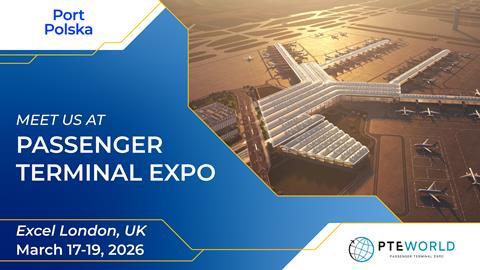

















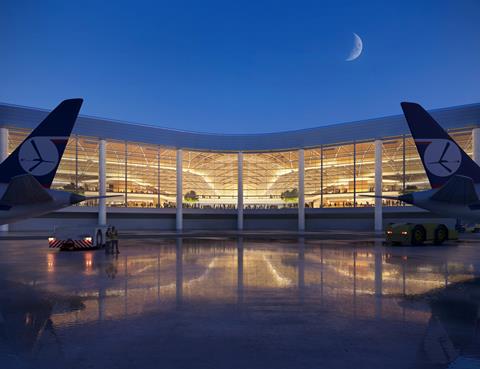
Poland is advancing a major infrastructure initiative with Port Polska, the country’s strategic investment programme led by Centralny Port Komunikacyjny. At its core is a new greenfield airport to be located between Warsaw and Łódź, complemented by upgraded road networks and a nationwide high-speed rail system. The hub, scheduled to open in 2032, is intended to serve as a fully integrated platform for passengers and cargo, representing a transformative step in the nation’s aviation and transport landscape.
A greenfield approach for operational excellence
One of Port Polska’s defining features is its greenfield design. Unlike older airports constrained by decades of incremental development and surrounding urban areas, this facility is being conceived entirely from scratch. Terminal layouts, apron configuration, airside and landside operations, digital systems, and surface access infrastructureare being planned together as a cohesive ecosystem.
This integrated approach allows optimization of aircraft movements, passenger and baggage flows, and separation of traffic streams from the earliest stages of design.Environmental considerations, such as noise mitigation, are being incorporated proactively, rather than retrofitted. For airlines, this holistic planning reduces operational bottlenecks, improves predictability, and ensures that infrastructure can evolve alongside changing fleet profiles and business models.
Building capacity for airline growth
Airports serve as the foundation for airline expansion, and the growth of LOT Polish Airlines underscores the need for scalable infrastructure. As the carrier expands its fleet and network, the new hub is designed to provide the capacity and connectivity necessary to support long-term growth. By aligning airport design with projected airline needs, Port Polska ensures that both passenger and cargo operations can scale efficiently, maintaining Poland’s competitiveness in Europe’s dynamic aviation market.
Multimodality at the heart of the design
Port Polska goes beyond simple terminal rail links. It is envisioned as an integrated air–rail–road hub, with high-speed and regional rail, along with road networks, central to its planning. Its strategic position between Warsaw and Łódź places it at the centre of a new high-speed rail network, significantly expanding its catchment area.
For carriers, this multimodal approach enlarges the passenger base, reduces reliance on short-haul feeder flights, and strengthens long-haul connectivity. Planning extends beyond the airport perimeter, with passenger access, transfers, and onward journeys treated as integral elements of the travel experience. Efficient surface access is critical for on time performance and customer satisfaction.
Enhancing passenger experience and operational flow
Terminal design is focused on continuous, end-to-end passenger journeys. Security checkpoints, border control, and wayfinding are optimized to reduce complexity and improve predictability. Cultural programming and thoughtfully structured commercial areas are integrated into the passenger experience, maintaining clear movement paths while maximizing exposure to retail and food offerings.
The combination of operational clarity and high-quality passenger experience supports smoother airline operations, higher satisfaction rates, and improved punctuality, reinforcing the airport’s role as a catalyst for both airline and economic growth.
Scalable Infrastructure and integrated cargo
The initial design accommodates 34–44 million passengers annually, with expansion built into the master plan. Cargo operations are integrated into the same coordinated system, with road access, rail links, logistics zones, and digital systems forming a unified framework.
An adjacent Airport City, including a Free Customs Zone, will create a hub for freight forwarders, integrators, and e-commerce operators. This arrangement enables efficient, predictable cargo flows, supports value-added logistics activities, and positions the airport-Airport City complex as a competitive gateway to the EU for intercontinental freight.
Digital systems and future-proofing
Digital integration is central to Port Polska’s vision. Tools such as a cargo management system will consolidate information, streamline communication among stakeholders, and improve process transparency. The project aligns with initiatives promoted by industry bodies like ACI Europe, advocating interoperable data standards and shared frameworks. Such digital cohesion allows airports to act as mobility coordinators rather than isolated infrastructure, paving the way for smarter, more integrated transport networks.
A long-term platform for airlines
Port Polska is more than a new airport – it is a forward-looking mobility platform. Airlines and other partners are engaged early in the planning process to ensure that infrastructure, operations, and digital systems are aligned with future requirements. By fostering collaboration and flexibility, the project is designed to remain adaptable, resilient, and capable of supporting Poland’s aviation sector for decades.