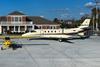
















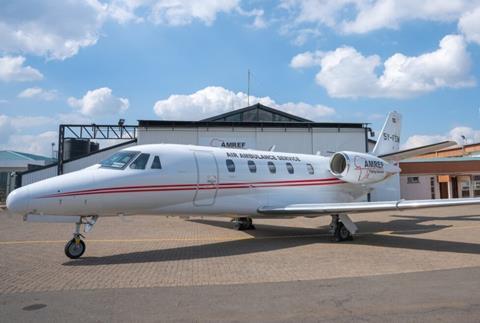
Kenyan investigators have yet to establish the cause of the recent air ambulance Textron Aviation Citation XLS crash in Nairobi, but there is evidence of smoke from one side of the aircraft during its descent.
The aircraft – operated by AMREF Flying Doctors – came down some 3min 25s after taking off from Nairobi Wilson airport’s runway 14 on 7 August.
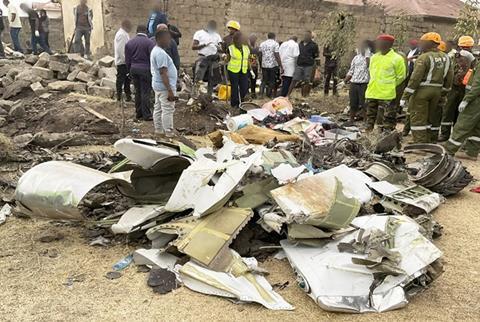
Kenya’s aircraft accident investigation department says it descended in a “high-energy, nose-down” attitude and struck a residential building adjacent to a church some 12nm northeast of the airport.
None of the four occupants survived, and two people on the ground were fatally injured.
“Various eyewitnesses reported observing the aircraft during its final moments before the crash,” says the inquiry.
“They stated that the aircraft appeared to spin to the right, with smoke emanating from its right wing. Additionally, witnesses reported hearing engine sounds during this time.”
This testimony appears to be reinforced by CCTV surveillance footage from residential buildings which captured various angles of the descent.
“The recordings show the aircraft spinning to the right, with smoke emanating from its right side,” says the inquiry.
Powered by two Pratt & Whitney Canada PW545B engines, the jet had been conducting a medical flight to Egal airport in Hargeisa, Somaliland.
Prior to take-off its crew had planned a cruise altitude of 41,000ft and reported a fuel endurance of 4.5h.
It was cleared for take-off, with an initial climb to 31,000ft, and directed to turn left, heading northeast to the AVENA waypoint some 24nm from the airport.
Upon contacting approach radar control for Nairobi’s main Jomo Kenyatta airport, the crew was initially cleared to 10,000ft and told to await further climb instructions.
Approach radar control then instructed the crew to fly to Mandera, about 400nm northeast, and climb to 41,000ft. The crew confirmed the clearance.
The inquiry says the data from approach radar control showed the aircraft at 11,900ft on a heading of 042°, climbing at 2,400ft/min.
But over the next 30s the groundspeed reduced from 251kt to 131kt and the distance from the NV VOR-DME beacon stopped increasing, before radar contact was lost completely.
Both the cockpit-voice and flight-data recorders sustained extensive physical damage from the impact. They are being analysed by the US National Transportation Safety Board.
Precise circumstances of the crash have still to be determined. The aircraft was carrying various types of medical equipment, including ventilators, a defibrillator, and oxygen cylinders.
Investigators state that much of the wreckage was located, but some parts were “pilfered” and local administrators had to deter scrap-metal dealers from purchasing these items. “That led to recovery of many of the parts albeit not at their original locations on impact,” says the inquiry.