













Confirmation that the UPS Boeing MD-11F which crashed in Louisville suffered a separation of its left-hand engine during take-off is likely to draw comparisons to the watershed McDonnell Douglas DC-10 accident in Chicago more than 45 years ago.
But while there are superficial similarities between the two occurrences, the inquiry is yet to ascertain whether they share any deeper parallels.
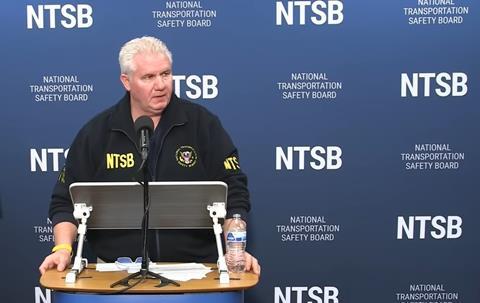
CCTV footage of the 4 November accident shows the left-hand GE Aerospace CF6 powerplant “detaching from wing during the take-off roll”, says the National Transportation Safety Board’s Todd Inman, a highly unusual event that also characterised the loss of American Airlines flight AA191 at Chicago O’Hare in May 1979.
The destruction of AA191 was jarring, not only for its appalling toll – it remains the US’s worst commercial aircraft accident – but also for photographs capturing its short flight, published at a time before social media numbed the impact of such startling images.
Development of the MD-11, essentially a stretched version of the DC-10, incorporated a number of design modifications and safety improvements in response to the crash. McDonnell Douglas hoped the trijet would compete on range against new rival twinjets, and overcome a reputational burden the DC-10 bore after a spate of high-profile occurrences.
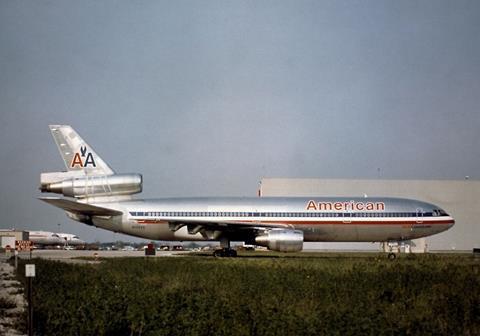
While the DC-10 had suffered early depressurisation events linked to the cargo door, the Chicago crash resulted from separation of the left-hand CF6 engine as the American DC-10-10 rotated from runway 32R.
The engine tore out 1m (3ft) of the leading edge – severing hydraulic lines – as it detached and fell backwards, over the top of the wing, onto the runway.
Hydraulic fluid normally kept the leading-edge slats extended against external airflow during lift-off and initial climb. But the loss of hydraulic pressure meant the airflow pushed the left outboard slats back to their retracted position.
Even though the aircraft had physically lost an engine, it continued to climb at 172kt (318km/h) and could have remained controllable had the crew known about the slat retraction, the safety board concluded.
“While other failures were not critical,” it said, “the uncommanded movement of these leading-edge slats had a profound effect on the aerodynamic performance and controllability of the aircraft.”
Retraction of the left-hand slats reduced lift from the left wing and increased its stall speed to 159kt.
Unaware of this situation, the crew followed American Airlines’ prescribed procedure for engine failure after take-off, maintaining an attitude which resulted in the aircraft’s slowing to below the left wing’s stall speed – at which point the aircraft suddenly rolled into a fatal dive.
“Simulator tests showed that the aircraft could have been flown successfully at speeds above 159kt,” the safety board found. “Or if the roll onset was recognised as a stall, the nose could have been lowered, and the aircraft accelerated out of the stall regime.”
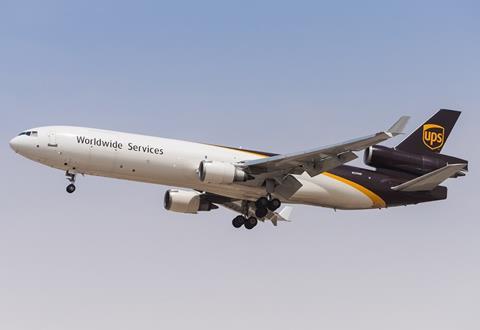
But while the crippled DC-10 had managed to maintain a climb rate of about 1,100ft/min after lift-off, and reached 300ft before the stall, the UPS MD-11F at Louisville appeared to experience difficulty gaining height after shedding its engine.
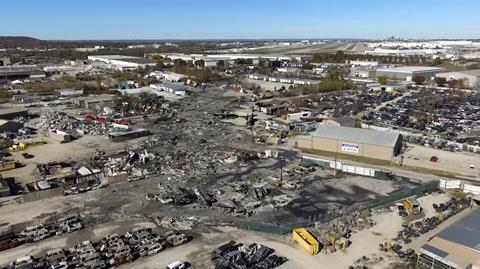
Flight 5X2976 “lifted off”, says Inman, attaining sufficient height to clear the fence at the end of runway 17R. Data indicates it reached perhaps 100ft, colliding with structures and coming down some 600-700m beyond the airport perimeter.
The reason for the aircraft’s failure to climb away has yet to emerge, and the inquiry will seek to determine whether there was a further loss of thrust beyond that from the detached engine, or an aerodynamic factor behind the jet’s performance.
Investigators will also need to understand the initiator for the engine separation – such as a structural issue, fire damage, or uncontained failure triggered internal or externally – as well as the breakaway sequence.
The inquiry into AA191 found the pylon had been damaged by improper maintenance procedures during engine removal. Some DC-10 operators, including American, had devised a time- and labour-saving measure to remove the engine and pylon as a single unit, using a forklift, but this risked inflicting overload cracks on the pylon. In the aftermath of the Chicago accident, carriers were advised to discontinue the practice immediately.
Although maintenance is naturally an area of interest for the UPS inquiry, investigators have not provided any detail about work conducted on the MD-11F airframe or its engines.
Inman states that the “bulk” of the MD-11F’s left-engine pylon was “still attached to the left engine” when the powerplant separated from the wing.
“The pylon was attached at the time that it disengaged from the aircraft,” he says. “Subsequently there could be damage that occurred upon its impact with the terrain.”
UPS will provide an exemplar aircraft to the safety board to assist with the probe.
Inman says the Teamsters union, representing UPS mechanics, is a formal party to the investigation, and specialists will be examining detailed maintenance records for the aircraft.
He says the safety board is “aware” that the aircraft had undergone a heavy maintenance check in San Antonio, but adds that the inquiry will be analysing all pertinent details on inspections.
“UPS has told us, at this time, there was no maintenance work done on the aircraft in question immediately prior to the flight that would delay it in any way, shape or form,” he says.
“Nothing to this point has been presented to us to dispute that. Our belief is, today, that there was not a maintenance issue regarding that aircraft prior to the flight.”
Engine separation from AA191 resulted in electrical power loss that left the captain’s slat-disagree and stall-warning system inoperative.
Knowledge that the crew might have been able to save the aircraft, but for the absence of crucial information as they dutifully followed the engine-out procedure, led to recommendations that such essential warning systems be made “completely redundant”.
The AA191 inquiry also recommended that operational procedures should be revised to increase stall margin. It pointed out that, without the instrumentation, the DC-10’s abrupt roll was the first warning the crew received that the jet’s wing had stalled.
One aspect of the UPS probe will be to assess whether, and at what point, the MD-11F crew might have understood their predicament – and whether, in the face of a rapidly-evolving emergency during a critical phase of flight, at high energy and low height, there was any course of action which the pilots could have taken. The Independent Pilots Association is among the named parties to the inquiry.
Irrespective of its echoes of AA191, the Louisville accident remains a standalone episode, with its own circumstances, causes and contributors.
“Every investigation is completely unique,” states Inman. “We walk into it from the very first steps saying we have no premise.
“All we can do is take the facts that are presented to us, analyse them, and then validate and try to come out with the best investigative report. Every one of them is completely different.”