













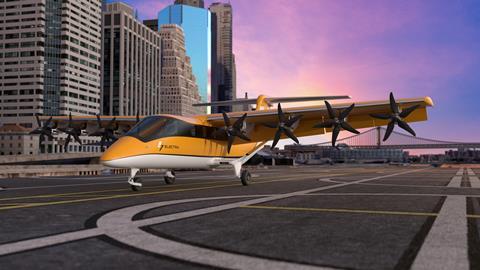
The nine-passenger hybrid-electric aircraft being developed by US start-up Electra will be powered by electric propulsion units (EPUs) supplied by UK motor maker Evolito.
Electra, based in Virginia, disclosed its partnership with Evolito on 13 October, saying the firm’s motors will drive the in-development EL9’s eight wing-mounted propellers. Service-entry is targeted for the end of this decade.
“Evolito will provide Electra with high-performance EPUs that integrate lightweight motors, high-integrity motor controllers and advanced thermal controls,” says Electra, which had previously disclosed few details about the EL9’s propulsion system. It has been working with Safran Helicopter Engines on the aircraft’s turbogenerators, however.
Evolito declines to disclose the power output from the motors it will be supplying for the EL9, but adds: ”We have been working with Electra for some time, developing requirements for their production aircraft.”
“We are already shipping development content in 2025 and will be shipping the first flight-worthy hardware to Electra in 2027. All hardware will be built or assembled in the UK at our Bicester facility.”
Certification for the motors is “aligned with that of the EL9”, Evolito says, with the goal of achieving service-entry “in an end-of-decade landing zone”.
Electra’s EL9 is to be an ultra-short take-off and landing aircraft with a blown-lift design, meaning its propellers will push air over the wing surface to generate additional lift.
The company’s chief executive Marc Allen has said a distributed electric architecture, in doing away with bulky wing-mounted engines, makes the blown-lift design feasible. In addition to the motors, the hybrid system will be composed of a battery pack and turbogenerator.
Electra says the aircraft will be able to take-off and land within about 46m (150ft), “unlocking thousands of new access points for air service”.
“Evolito’s lightweight, durable and cost-effective design will provide exceptional long-term value for operators through low maintenance, long life and proven reliability,” says Allen.
Electra is still finalising the design of its EL9, which it says will cruise at 175kt (324km/h) and have 1,100nm (2,037km) of range. It aims to fly the EL9 prototype for the first time in 2027 and to begin certification-credit flights in 2028 or 2029.
Several other start-ups are working with Evolito, including Vaeridion, for its in-development nine-passenger Microliner concept, and Flying Whales, which will use D250 motors on its in-development LCA60T airship.