











Russian intellectual property authorities have registered a patent from aerospace firm United Aircraft detailing a proposed widebody twinjet aircraft family, with three variants, in the 240- to 320-seat range.
Illustrations accompanying the proposal show a design strongly resembling the Boeing 787, featuring wingtips similar to those on the Airbus A350.
The dimensions listed, including a fuselage length of 58.4-68.6m and a span of 59.6m, are close to those of the 787-8 to -10 family.
Its wings would have a 32.6° sweep and an aspect ratio of 10.47.
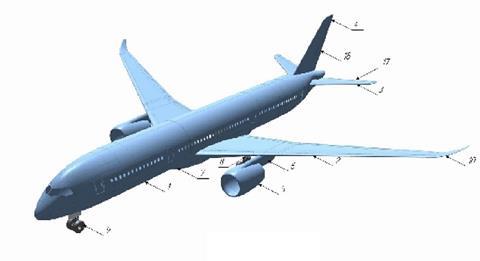
According to the patent, authored by six United Aircraft individuals and obtained by FlightGlobal, the proposal is designated the ShFDMS – an acronym for widebody long-range aircraft – and the family would comprise the -500, -600 and -700 variants, capable of operating over ranges of 5,560-7,340nm (10,300-13,600km).
It refers to the ShFDMS-600 as the basic model, featuring a 281-seat layout in three classes. This -600 variant would have economic advantages over the Boeing 787-9, it claims, such as an 11-13% operating cost saving per seat-kilometre.
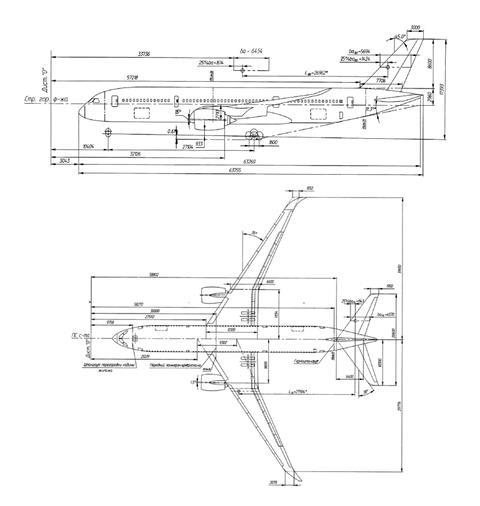
According to the document, the proposal aims to address the need for “improved technical and operational characteristics” by using polymer composite material in construction.
While the nose section of the six-section fuselage would be metallic – to offer resistance to bird-strike – the remaining fuselage sections, vertical fin and horizontal stabiliser would be formed from polymer composite panels. The wing boxes would also have composite structures along with metal ribs.
Its oval passenger cabin would have an internal width of 5.6m, enabling configuration in a nine-abreast 3-3-3 layout.
There is little detail about the engine requirements for the aircraft family. The patent was submitted at the end of December 2024 and registered on 1 August this year.