












Ever since Volocopter flew a series of demonstration flights with its autonomous air taxi prototype over Jumeirah Beach eight years ago, Dubai and Abu Dhabi have been determined to ensure the UAE becomes the birthplace of commercial electric-powered urban air mobility (UAM).
After exploiting their position on the globe to create mega airlines and hubs from scratch and ascend to the global elite of commercial aviation players, they are determined to do the same at the other end of the air transport scale, with electric vertical take-off and landing (eVTOL) aircraft.
This year, several eVTOL aircraft will be displaying at the Dubai air show, with at least one taking part in the flying display for the first time, in what organisers describe as “a defining moment for the event and the future of aviation”.

Volocopter will not be among them. Although it set an early pace in the race to launch paid eVTOL passenger services, the German start-up’s aspirations were halted by insolvency in late 2024. Its intellectual property and assets have since been acquired by the Chinese owners of Austria’s Diamond Aircraft.
In its place, two US developers – Joby and Archer – have become the front-runners to launch the first commercial eVTOL services in the Gulf state, after securing partnerships with the governments of Dubai and Abu Dhabi, respectively.
TAXI SERVICES
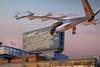
In June, Joby carried out the first test flight of its aircraft in Dubai. It followed a 2024 exclusive agreement between the Californian firm, Dubai’s Roads and Transport Authority, and Skyports, a UK company specialising in vertiports and UAM infrastructure, to begin air taxi services on routes within the city early next year.
Joby is working with the UAE regulator, the General Civil Aviation Authority (GCAA), to qualify the aircraft for passenger service, and “bring this project to life”, says Anthony Khoury, UAE general manager at the company.
So far, it has carried out more than 20 piloted test flights. All have been over remote parts of Dubai, but “as we build more confidence, we will get closer to populated areas”, says Khoury.
The UAE’s geography, together with its top-down, federated form of government – where each emirate’s rulers can drive policies and investment decisions quickly – and the fact that it has its own commercial aviation regulator, makes it easier perhaps for a UAM ecosystem to emerge there than in most other countries.
However, there is a major challenge when it comes to operating any form of aircraft there, but particularly rotorcraft. The region’s hot and dusty climate can be brutal when it comes to the durability of any rotating parts. This is something Joby’s engineers and test crews have been working through.
“We’re designing this aircraft to operate in a wide range of environments,” says Khoury. “We’ve been flying it here over the summer and also at Edwards Air Force Base [in California], so we are building up a lot of data as to how it will cope in desert conditions.”

The plan is for Joby to initially operate commercial flights in Dubai under its own air operator certificate, linking Dubai International airport (DXB) with downtown Dubai, the Palm and Dubai Marina. When it launches in other parts of the Gulf, it may work with partners, says Khoury.
Joby’s main partner in the project is Skyports, which is in the final stages of building its first vertiport, just outside the perimeter of DXB, in a former car park behind Emirates’ headquarters, and next to a station on the Dubai Metro.
The three-storey, “flagship” structure is scheduled to open by the end of the first quarter and will be the “first commercial vertiport in the world dedicated to eVTOL”, says Damian Kysely, Skyports head of EMEA.
The three other, smaller locations will follow by the end of 2026 and likely double as pads for traditional helicopters. Although Joby will be the exclusive eVTOL user at first, the vertiports will eventually be opened to other operators and types, he adds.
The relationship with rotorcraft is important. Kysely expects electric air taxis to “replace helicopters in a lot of use cases” as public acceptance grows and they become an everyday mode of transport for crossing the city. He says each vertiport is designed to handle 10 landings an hour and 170,000 passengers annually.
Two hours’ drive away – or under 30min in an electric air taxi – in Abu Dhabi, Joby’s fellow Californian developer Archer is in a parallel process with that emirate, after flying its Midnight aircraft for the first time at the Al Bateen executive airport in the city earlier this year.
Archer has since been working with the regulator and the Abu Dhabi authorities as it expands its flight-test programme in the region, like Joby focused on “evaluating the aircraft’s performance in UAE-specific conditions, including temperature, humidity and dust exposure”.
LOCAL PARTNERS
In contrast to Joby, which will operate the initial commercial service itself, Archer is partnering with established local helicopter specialist Abu Dhabi Aviation (ADA), which in March announced a memorandum of understanding (MoU) to acquire and operate an undisclosed number of Midnight aircraft.
On the infrastructure side, in April, the GCAA approved the design for the transformation of a helipad at Abu Dhabi’s cruise terminal into a hybrid heliport for helicopter and eVTOL aircraft operations.
Beyond the UAE, the start-up has also signed a “strategic partnership” with Dubai-headquartered business aviation services company Jetex, “focused on developing infrastructure” across Jetex’s international portfolio of more than 40 private terminals.

Archer plans to expand to other emirates and then across the broader Gulf region, to the likes of Saudi Arabia, Kuwait, Bahrain, Qatar and Oman, explains founder and chief executive Adam Goldstein. But the UAE will see the first operations.
“The UAE has been forward leaning when it comes to new technologies in aviation, and they have created incredible cities,” he says. “You have booming economies and cities such as Abu Dhabi and Dubai that are close enough together for UAM to be practical.”
There has been “all-round buy in”, he adds. “The regulator is very supportive, [Abu Dhabi sovereign investment house] Mubadala was an early investor, and Etihad Training and ADA have been big partners.”
He hopes to gain GCAA certification shortly, with “revenue coming in next year”. Initial commercial operations will “start conservatively”, with Archer pilots working with their customers, as services get off the ground.
TRAVEL PATTERNS
In terms of travel patterns, he anticipates Abu Dhabi-Dubai – a downtown-to-downtown journey that can take more than two hours if traffic is bad – to be the most popular route, with connections to other UAE cities also coming into play.
“But it’s hard to understand how people will use these until we get going,” he admits. “Will it be chiefly leisure, or commuting? Ultimately, it will probably be about saving time, which is essentially why rich people use helicopters. It’s the convenience.”
Embraer offshoot Eve inked a deal with Abu Dhabi-based business aviation and helicopter operator Falcon Aviation Services (FAS) in 2022 to deliver 35 of its electric air taxis with a view to launching tourist flights in Dubai in 2026. However, Eve says that letter of intent has expired.
Instead, Eve has signed an agreement with Bahrain that could see commercial operations begin there in 2028, and an MoU with Saudi carrier Flynas to “explore” air taxi operations in Riyadh and Jeddah.
The Brazilian outfit says its platform is “engineered for the Middle East’s unique climate” because its “lift and cruise” design exposes lifters to less potential erosion from sand and dust, as they only operate at take-off and landing. It also comes with UV and IV protection on the windows and “smart air conditioning”.
Meanwhile, FAS appears to have switched allegiance to Chinese contender Autoflight, announcing late last month a commitment for 50 of its aircraft – 15 V2000CG cargo platforms and 35 of the still-uncertificated V2000EM passenger version.
FAS says the first batch of cargo aircraft, to provide services to the Abu Dhabi National Oil Company (ADNOC), is due this year. FAS is a “strategic partner” of the UAE government in developing a network of vertiports.
Other developers have been eyeing the UAE market. Last year, fellow Chinese company EHang, which has had its EH216-S certificated in China, completed its first UAE demonstration flight with the type, in Abu Dhabi, carrying Emirati royalty and civil aviation officials. It also carried out a flight in Mecca, Saudi Arabia.
Also in 2024, Dubai business Aviterra, which was started by one of the founders of Jetex, declared it was acquiring 100 Liberty flying cars from Dutch developer PAL-V to bring the product to the Middle East and Africa.
The Liberty, a hybrid gyroplane designed to fly and travel by road, is uncertificated but earlier this year PAL-V received a “No Technical Objection” notice from the European Union Aviation Safety Agency: the first to have been issued by the regulator for a so-called “FlyDrive” vehicle.

While Abu Dhabi and Dubai are leading the UAE’s efforts in UAM, the country’s smaller emirates are also looking for a piece of the action. In July, Ajman signed an MoU with Skyports to “explore opportunities for co-operation in the field of smart aerial transport” as part of its “transformation into a smart city”.
In September, Joby and Skyports began working with Ras Al Khaimah to launch an air taxi service by 2027, linking Dubai with Al Marjan island, where the prestigious Wynn resort is due to open in 2027, as well as the emirate’s airport. Kysely says Skyports wants to create an “Emirates-wide” network of vertiports.
It follows a regulatory framework published in 2023 for vertiports, and one in 2025 for “hybrid operations”, that allows eVTOL aircraft and conventional helicopters to “operate interchangeably on the same infrastructure”. It says regulatory efforts are underway to convert 100 heliports across the country into hybrid vertiports.
The GCAA’s objective is to “ensure the safe and efficient integration of large commercial aircraft and emerging urban mobility vehicles”, an approach, it says, that “serves the country’s vision and reflects its commitment to balancing innovation with the highest standards of operational safety in civil aviation”.
However, enthusiasm about UAM’s promise may not be enough. Many developers are entering a critical period when huge sums will be needed to complete certification and scale production at a time revenues are minimal. There have already been casualties in a sector in which many believe only a handful can survive.
There is always a danger of hubris. In September 2017, after carrying out its demonstration flights in Dubai, Volocopter was proclaiming that “a new era of public transportation has begun today”. Seven years later – with its family of aircraft still not certificated – it ran out of money.