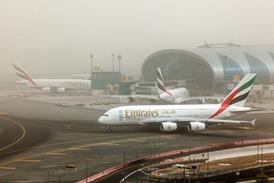













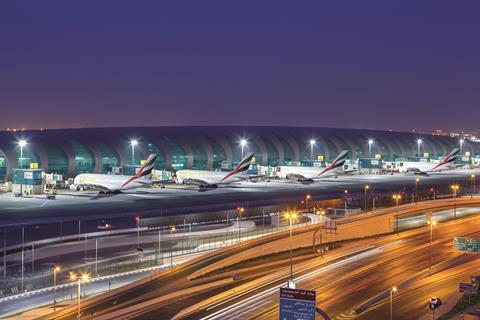
Emirates Airline has embarked on an ambitious project with Thales and Dubai’s air navigation service provider designed to reduce holding times for flights arriving at Dubai International airport.
Under the collaborative research agreement, the trio will work together on innovative solutions to improve air traffic management.
This will include the integration of advanced AI technologies which will “play a pivotal role in identifying potential congestion areas” and providing solutions to the parties.
By identifying likely bottlenecks early, the system will be able to slow the cruise speed of inbound flights, better staggering their arrival, and reducing fuel-burn caused by unnecessary holding time.
Thales already provides its systems to Dubai Air Navigation Services (DANS) and Emirates’ fleet also makes extensive use of the French company’s avionics.
This “makes it very feasible to work with them on optimising their airspace”, says Yannick Assouad, Thales executive vice-president for avionics.
“This research agreement with Thales and DANS represents a practical application of AI to solve a real operational challenge,” Adel Al Redha, chief operating officer at Emirates.
“By predicting congestion and adjusting cruise speeds proactively, we not only reduce fuel burn associated with holding patterns but are also optimising our operational efficiencies.”
Thales has also signed a separate agreement with the UAE’s Tawazun Council for Defence Enablement to support the development and implementation of an advanced Air Traffic Flow Management (ATFM) system.
It will be operated by the General Civil Aviation Authority with Global Air Navigation Services as a national partner.
Thales will work with two partners to develop the new ATFM system, initially based on its existing software while also working on new features through a new ATM Innovation Lab - the first of its kind in the UAE, and Thales’ fourth such facility globally.
In addition, Thales sees broader engagement with other national stakeholders, including the airport operators in Abu Dhabi and Dubai, and Abu Dhabi carrier Etihad Airways.
Meanwhile, Thales is eyeing a busy delivery push on its Avant Up in-flight entertainment (IFE) system over the coming years having been selected by Emirates for its Airbus A350 and Boeing 777X fleets.
Emirates has already taken delivery of 13 A350-900s, with another 60 on order, while the carrier’s 270 on-order 777Xs will only start arriving from 2027.
Thales was in 2017 chosen by Emirates to equip the 777Xs with the earlier Avant system, but repeated delays to the widebody programme saw the contract updated to cover the newer Avant Up suite.
But, says Assouad, with deliveries again pushed back that may change once more. “I believe the expectation is that before we deliver [for all the] airplanes it is likely we will revamp that contract again.”
This will probably be for Thales’ cloud-based FlytEdge IFE product and the possible inclusion of a next-generation screen, she says. That same system has already been adopted by Qatar Airways on its A321neo fleet.
In part due to Emirates’ commitment, Thales has opened a research centre in Dubai focused on developing “sophisticated functionality” for IFE, she says. Its creation is in addition to an existing avionics and IFE repair station in the emirate.