














More than a decade ago, Boeing provided submersible operator OceanGate with a feasibility study related to the design of a carbon-fibre hull for a deep-sea submersible.

In that report, Boeing, drawing on its extensive experience with carbon-fibre materials, made numerous recommendations aimed at ensuring the integrity and safety of such a hull.

Now, the US Coast Guard (USCG) says OceanGate failed to follow many of Boeing’s recommendations when designing the Titan submersible that imploded in 18 June 2023 during a dive to the wreck of the ocean liner Titanic.

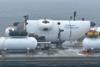
OceanGate Titan submersible

Source: United States Coast Guard

OceanGate failed to incorporate Boeing’s recommendations when designing the Titan submersible, says the USCG

The implosion happened at a depth of roughly 3,350m (10,991ft) and killed all five people aboard, including OceanGate co-founder and chief executive Stockton Rush.

“Boeing had given OceanGate a roadmap of potential failure areas and specific items to focus on during the design phase,” the USCG says in its final accident report, released on 5 August. “However, many of these items were either inadequately addressed, or not addressed at all by OceanGate due to time and money concerns.”

Titan imploded after its hull lost structural integrity, the result of “either the adhesive joint between the Titan’s forward dome and the titanium segment, or the carbon-fibre hull near the forward end”, the report concludes.

While numerous factors contributed to the incident, the USCG stresses OceanGate’s failure to follow Boeing’s recommendations. Boeing’s work with OceanGate had been previously reported.

But the USCG’s accident report reveals more about Boeing’s involvement, which occurred years ago, early during OceanGate’s development work.

Boeing decided to stop supporting OceanGate after completing the preliminary feasibility study because “OceanGate did not follow their recommendations from the report”, the USCG notes.

“Boeing was not a partner on the Titan and did not design or build it,” adds Boeing.

Early last decade, OceanGate engaged Boeing to complete a “comprehensive feasibility analysis for a deep-sea submersible” made from composites including carbon fibre reinforced plastic, which is “used extensively in the aerospace industry”, says the USCG. The University of Washington Applied Physics Laboratory was also involved in early design work.

At the time, OceanGate was developing its Cyclops submersible, which was intended to be capable of diving to 8,600m. Cyclops was a precursor to Titan, a later design.

Delivered to OceanGate in 2013, Boeing’s study raised concerns and made numerous recommendations that OceanGate failed to adopt when designing Titan, says the USCG.

For instance, Boeing recommended a 17.8cm (7in)-thick composite hull, though Titan’s hull was 12.7cm thick.

“Boeing’s feasibility study found that a carbon fibre hull was technically possible but identified several critical challenges, including manufacturing defects, bonding issues and thermal stresses during curing,” the USCG says. “Despite Boeing’s recommendations for additional testing and process monitoring, OceanGate’s final design reduced the hull thickness, excluded key… structural elements and failed to implement [non-destructive testing] or advanced modelling, leaving significant uncertainties about the submersible’s integrity.”

Boeing had also “stressed the importance of validating assumptions and performing extensive tests,” the USCG report adds. “OceanGate failed to dedicate the requisite time and resources to these crucial processes, which likely contributed to undetected vulnerabilities in the submersible’s hull.”