











To understand the importance of Middle East customers to Boeing’s future, look no further than a little signing event that took place on 14 May in Qatar.
Four people attended. You might have heard of them: US President Donald Trump, Qatari Emir Sheikh Tamim bin Hamad al-Thani, Boeing chief executive Kelly Ortberg and Qatar Airways CEO Badr Mohammed Al-Meer.
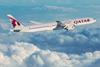
There, broadcast live, the Qatar Airways chief signed for what Boeing called its “largest-ever widebody order”: a commitment to purchase 160 jets, including 130 787s and 30 777-9s. The carrier also took options on 50 of the widebodies.

That event not only solidified Qatar as among Boeing’s best customers, it reflected the outsize role Middle East carriers play in Boeing’s future. It also revealed the degree to which Trump will throw his weight behind Boeing’s success.
“That’s a record, Kelly,” Trump, who was in Qatar for trade negotiations, told Ortberg after the signing. “That’s a congratulations to Boeing. Get those planes out there.”
Since taking office in January, Trump, pursuing his “America first” agenda, has used Boeing jets as tools of leverage, pushing trading partners to place orders – with great success. Again and again, countries and their airlines have committed to buy Boeing jets as part of trade agreements with the USA.
“You’ll notice a constant trend: where there is a Trump trade deal, there’s a Boeing sale,” US Treasury secretary Scott Bessent said on 7 November. “This administration backs Boeing because Boeing backs America.”
Ortberg last month presented Trump with the “salesman of the year award, in the Oval Office”, Bessent adds.
Qatar aside, Trump’s trade talks have coincided with Boeing securing orders or commitments this year from Bahrain, Indonesia, Japan, Kazakhstan, Malaysia, Saudi Arabia, South Korea, Tajikistan, Thailand, Uzbekistan and Vietnam.
Of the Uzbekistan deal – an eight-strong 787 order from Uzbekistan Airways revealed on 6 November – Bessent said, “President Trump was urging [Uzbek president Shavkat Mirziyoyev] to buy more”.

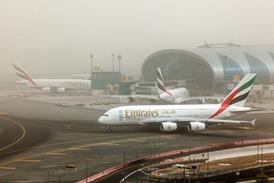
During the Dubai air show on 17 November, news broke that Emirates ordered another 65 777-9s – that airline’s third order for the type, bringing its total 777X commitments to 270 jets.
In 2025 through October, Boeing landed 321 787 orders (five times more than in all of last year), of which at least 194 (60%) were from countries and carriers based in the Middle East and nearby nations, including those in Central Asia, Boeing’s data shows. Qatar’s and Emirates’ 777X orders account for 58% of the 162 orders for that type Boeing has revealed this year.
Boeing likely would have landed some of those orders without Trump’s hand and is quick to cite the 787’s capabilities as a factor.
“The airplane does a very good job in service. Our customers know that it’s an efficiency leader…It beats the competition,” says Boeing 787 marketing director BJ Bryan.
Such demand has prompted Boeing to hike 787 output, moving this year from five to seven jets monthly. It aims before year-end to hit eight monthly and in 2026 to reach 10 – the maximum possible at its single 111,500sq m (1.2 million sq ft) 787 site in North Charleston, South Carolina.
Envisioning eventual additional hikes, Boeing on 7 November revealed plans to build a second 787 assembly facility adjacent to and roughly the same size as the first. Boeing expects the second site will be operating in 2028. It is investing $1 billion in the project, which also involves opening a “parts-preparation area facility, a vertical fin paint facility [and] flight-line stalls” in North Charleston.
“We are preparing Boeing South Carolina for decades of 787 production,” Boeing Commercial Airplanes CEO Stephanie Pope said during a Boeing event marking the project’s groundbreaking. “One day your children, or maybe their children, will write the next chapter of Boeing’s story.”

In many respects, Boeing’s performance this year reflects a company making real progress toward overcoming a slew of recent problems. For more evidence, look no further than Boeing’s most-recent delivery figures.
In the first 10 months of 2025, Boeing handed over 493 aircraft – 145 more than in all of 2024. Those included 364 737 Max (56% more than in the same 2024 period), 31 777s (up 182%) and 68 787s (up 70%).
Impressive gains any way you slice it.
PRODUCTION PROGRESS
In addition to hiking 787 output, Boeing has accelerated 737 production, thanks partly to the Federal Aviation Administration recently approving it to produce 42 of the jets monthly, up from 38. (The agency capped 737 production after the 2024 in-flight failure of a Max 9’s mid-cabin door plug due to manufacturing oversights.)
Boeing plans to end this year producing 42 737s monthly, to hit rate 47 in 2026 and to eventually achieve rate 52. It requires FAA approval for each bump.
On 31 October, credit rating firm S&P Global Ratings revised its outlook for Boeing to “stable” from “negative”, noting, “737 Max manufacturing is meeting key consistency metrics” and “engine supply has kept pace with production”.
“We view management as having effectively executed the production ramp-up and quality control improvement,” S&P adds. “These gains place Boeing in a stronger position to address sizable remaining challenges.”
Meanwhile, Boeing has nearly divested undelivered jets that it had produced but not delivered due to factors related to required rework, the Covid-19 pandemic and tense US-China relations.
Boeing ended September with five undelivered 737 Max 8s and 10 undelivered 787s out of groups that once included some 450 Max and 120 787s.
The FAA also recently returned to Boeing authority to issue some 737 and 787 airworthiness certificates, after revoking the privilege amid Boeing’s quality struggles.
And Boeing on 2 November raised $10.6 billion by selling digital companies AerData, ForeFlight, Jeppesen and OzRunways, a move Ortberg says will help Boeing retain a solid credit rating and shifts its focus more toward building aircraft.
To be clear, Boeing’s recovery is far from complete, and in some respects taking much longer than it predicted.
Numerous high hurdles must still be cleared, including achieving the 777-9’s certification. That programme took another delay on 29 October when Boeing pushed back its expected first delivery again, to 2027 from 2026.
That same day, Boeing reported losing $5.3 billion in the third quarter, largely reflecting a $4.9 billion non-cash charge taken against the 777X programme.
To its credit, the company has provided some detail about the 777-9’s hold ups.

The latest postponement comes down to a unique approach the FAA has taken in approving the 777-9’s Type Inspection Authorization (TIA) – a document that confirms an aircraft is expected to meet certification standards and that authorises flight tests for certification credit.
In the past, the FAA approved Boeing’s TIAs in their entirety. But the agency has been approving the 777-9’s TIA in portions under an “incremental TIA process”, says Ortberg. “We very much underestimated how much work it was going to take for us to get the TIA approvals and for the FAA to have the opportunity to review all the data submissions.”
As a result, though Boeing has completed more than 4,000h of 777-9 flight testing – “more than double a typical flight-test programme” – those hours cannot all be credited toward certification, the CEO adds.
There are no “new issues with the airplane itself or the engine”, Ortberg stresses. “Demand for the airplane remains strong.”
Boeing ended October holding unfilled orders for 565 777X, including 463 777-9s, 59 777-8 Freighters and 43 of the 777-8 passenger variant. It expects to deliver the first 777-8F two years after delivering the first 777-9, and expects to send the first 777-8 to customers after 2030.
The fresh 777-9 delay did not shock some customers, with Carsten Spohr, CEO of 777-9 launch customer Lufthansa Group, saying his team “never expected” to have the jet in service in 2026.
Boeing also must achieve certifications of two outstanding Max models: the smallest variant, the Max 7, an aircraft Southwest Airlines has been banking on to fuel expansion, and the largest variant, the Max 10, Boeing’s primary answer to Airbus’s fast-selling A321neo. Boeing says both should be certificated in 2026.
Those programmes are years behind schedule and now on hold while Boeing redesigns an engine anti-ice system.

Boeing had the opportunity, in disclosing the latest 777-9 delay, to also delay the Max 7 and 10 programmes. But it chose not to, suggesting Ortberg has a fair degree of confidence in the 2026 timetable.
“We think it’s pretty straightforward to get through the certification of the design,” he says of the anti-ice project. “We’re still planning on getting that done in 2026.”