














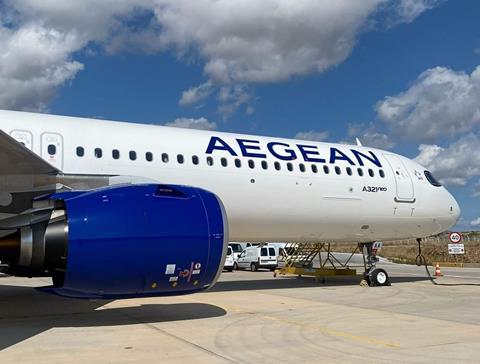
Greek carrier Aegean Airlines has scrapped plans to take a pair of Airbus A321XLRs to launch flights to India this year after delays in receiving the aircraft meant they would not arrive in time for the summer.
Aegean last year announced plans to supplement its planned new longer-range sub-fleet of A321LRs with the addition of two A321XLRs. These aircraft were due for delivery in December and January, and Aegean planned to use them to accelerate the launch of flights to Mumbai and New Delhi.
“We were going to get [two XLRs] from another airline that wished to cancel them,” explained Aegean Airlines chair Eftichios Vassilakis, speaking during a full-year results call on 12 March. ”With those aircraft there has been a problem in terms of some certification issues on the seat. The deadline to receive them was put back by around seven to eight months.
”That created a situation where the arrival of the aircraft, basically by the end of the summer and into autumn, would have made them rather redundant for us because they were meant to accelerate our entry in longer distance markets, like India mainly.”
He says that because the airline is already due to take delivery of the first of its four A321LRs next year, Aegean has taken the decision to cancel the two XLRs.
The commitments for two XLRs had taken Aegean’s overall Airbus A320neo family commitments to 60, six of which would be a sub-fleet of longer range aircraft in a dedicated configuration designed to serve markets beyond Europe. Aegean still plans to retain that fleet mix, albeit with LRs instead.
“We have replaced the overall capacity with two regular A321neos coming from another opportunity that is available towards the end of the year,” Vassilakis says. “And we are looking at converting two more of our order for regular A321s into LRs so that the sub-fleet of LRs able to fly longer distances and which have a very different product specification will remain at six, as would have been if we had received the XLRs.”
He notes both positive and negative impacts from the removal of the XLR from its fleet mix. ”The plus is we will have a homogeneous fleet of six, as opposed to two sub-fleets which would have made things a little more confusing,” Vassilakis says. ”On the other hand, we have pushed back our launch into the Indian market effectively by one year between the delay and the arrival of the new aircraft.”
Aegean will this year add seven additional A321s to the fleet and, while the total number of aircraft grounded due to problems related to the Pratt & Whitney PW1100G engine issues is likely to be unchanged at around 10 during July and August, it means the carrier expects to have 33 rather than 26 Neos flying this summer.
Despite ongoing challenges in aircraft availability, the Greek carrier lifted pre-tax profit 17% to €192 million ($221 million) in 2025 on revenues up 5% to €1.86 billion.