















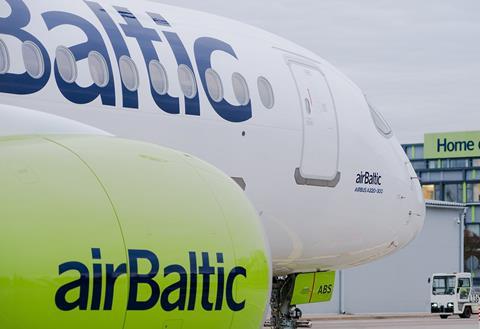
Latvian carrier Air Baltic expects to have its full fleet of Airbus A220-300s available for operations this year after reaching a “turning point” on engine maintenance-related issues in 2025.
Air Baltic cut its full-year net loss by 40% in 2025 to €44.3 million ($51.2 million), but incurred extra costs as it had to bring in additional wet-lease capacity because of unavailable aircraft to operate its peak summer schedule. The carrier ended 2025 with a fleet of 51 Pratt & Whitney PW1500G-powered A220-300s.
Speaking during a full-year results call, Air Baltic chief operations officer Pauls Calitis said: ”2025 was a turning point in terms of the performance of the engine. In 2025 we saw for the first time that the engine removal rate or availability was stable and as forecast, and as a result, in 2025 we only had three aircraft that were needed for the summer season from external providers.”
The carrier averaged four aircraft on the ground in the fourth quarter – compared with 13 in the same period a year before.
”The availability went to forecast and by the end of 2025, we actually had all engines available,” Calitis adds. ”In 2026 the year has also started and continued to be in line with this, meaning we currently have a small surplus of engines available for our fleet and we do not plan to have any external capacity need for the peak of 2026.”
Air Baltic has already taken two further A220s and will add three more by mid-year to reach a fleet of 56 A220s.
New Air Baltic chief executive Erno Hilden, who took the helm of the carrier in December, adds: ”We expect to be able to operate the entire fleet during 2026 with no significant limitations from engine availability or other reasons.”
Hilden says the carrier, which has been developing its wet-lease business alongside scheduled operations, expects to increase capacity by around 15-20% this year, ”driven by an 8-10% increase in scheduled flying and a substantial 30-40% increase in ACMI capacity [flying]”.
Air Baltic will keep its fleet at 56 over the second half of the year and through 2027, before further growing the fleet from 2028. ”As such we have agreed with Airbus the revised delivery schedule and we do plan to continue the fleet growth to reach close to 100 aircraft by the end of 2032,” says Calitis.