











SmartLynx Airlines’ operations in Estonia and Malta have followed the wet-lease specialist’s Latvian arm and been sold to its management and Dutch company Break Point Distressed Asset Management.
Former owner Avia Solutions Group (ASG) disclosed on 23 October that it had sold Latvian-registered SmartLynx Airlines but said it would retain the carrier’s Estonian and Maltese arms, merging and rebranding them in the process.
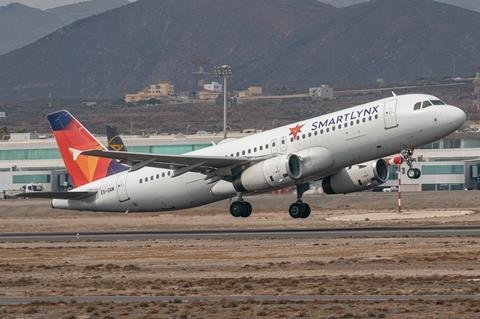
But in its third-quarter financial report on 25 November, ASG disclosed a change of course: it had over the previous month “disposed of” its stakes in “SmartLynx Airlines Estonia OU and Air Holding Limited and their respective subsidiaries”, it said.
ASG now confirms it has divested the businesses, for an undisclosed fee, to the same owner: ”Due to operational synergies, the Maltese and Estonian [operations] were subsequently sold to the same group, enabling unified oversight across the three entities.
”Since the sale, all decisions relating to those [units] have been taken exclusively by the new owners. The divestment process was conducted in full compliance with EU regulations and all relevant legal requirements.”
SmartLynx Airlines Estonia had been 100% held by Ireland-based ASG Aero Asset Invest – an Avia Solutions Group subsidiary – the Estonian business register shows.
But as of 5 December, its shareholders are listed as Break Point Distressed Asset Management (90.77%), alongside SmartLynx Airlines chief executive Edvinas Demenius and chief financial officer Mindaugas Kazakevicius (4.62% each).
While ASG founder and chairman Gediminas Ziemelis had been recorded as the company’s sole beneficial owner, that ceased on 25 November this year when he was replaced by two other individuals, Elias Heracleous and Maria Xeni, who are now listed as indirect owners of the business.
Meanwhile, SmartLynx Airlines Estonia also holds a single share in Air Holding Ltd – the immediate parent company of SmartLynx Airlines Malta, the Maltese business register shows. However, this has not been updated since 23 September.
The remainder of Air Holding’s 66,667 shares were split between ASG (64,667) and SIA SmartLynx Airlines (1,999) – the registered name for the Latvian business.
SIA SmartLynx Airlines in turn held a single share in SmartLynx Airlines Malta, with Air Holding owning the rest of its 2,000 shares, according to Malta’s business registry.
There have been no recent changes recorded to the ownership of either Air Holding or SmartLynx Airlines Malta, although the registry on 10 December disclosed that the company secretary for both businesses had resigned on 28 November.
Ceased operations
In the meantime, SmartLynx Airlines lasted barely a month under Break Point’s ownership, announcing on 24 November that it was ceasing operations after an evaluation of its financial situation and long-term prospects.
Dutch company registration documents show Break Point was incorporated on 19 September with Elias Heracleous, a Cypriot national, its sole director.
Although ASG said in its accounts presentation that it had provided over €130 million ($150 million) of financial support to SmartLynx Airlines “becoming its major creditor”, ASG has not clarified if it is also owed money by the Estonian and Maltese units.
”As the largest creditor of the divested SmartLynx entities, through historical operational funding, the group has full visibility over the separation but no ongoing obligations,” ASG adds.
SmartLynx Airlines’ creditors list shows €117 million associated with ASG Finance, a division of the larger group, while another €51 million is claimed by the Estonian and Maltese operations.
Additionally, there have been no updates on the status of those two businesses, with neither currently listed as in formal insolvency. Aircraft tracking data shows both carriers’ fleets are now parked, however.
Neither the Estonian nor the Maltese units have submitted up-to-date financial statements, in each case the most recent available cover the 12 months to 31 December 2023.
ASG says filing of the accounts was delayed ”because the management teams at those [operations] were awaiting essential information from third parties required to finalise the accounts.”
During 2023, both carriers were in the black: SmartLynx Airlines Estonia made a profit of €555,000 on turnover of €86 million – up on respective figures of €363,000 and €56 million in 2022 – while the Maltese business made a net profit of €8.9 million on income of €144 million, versus a €2.9 million loss on €113 million turnover in the prior period.
But while SmartLynx Airlines Malta was profitable, the accounts note that as of 31 December 2023, its then current liabilities exceeded its assets by €53.1 million.
Those accounts also disclose that in May 2023, UK carrier Jet2 lodged a UK High Court claim against the operation seeking £3.05 million ($4.02 million) in compensation for the breach of a wet-lease contract; the pair eventually reached an out-of-court settlement for £1.8 million.
“The directors believe that the use of [the going concern] assumption is appropriate taking cognisance of the continued support of the parent company,” the accounts state.
SmartLynx Airlines Malta ended that year with 32 aircraft in its fleet – 19 Airbus A320-family jets, four A330s and nine Boeing 737s; lease liabilities at 31 December stood at €272 million, the accounts show, up sharply on a figure of €58 million a year earlier.
Crew Complaints
Although many businesses are owed money from SmartLynx Airlines’ insolvency, those working for the airline have borne the immediate brunt of its closure.
Crews from the Latvian operation were scattered across the globe where they had been working on wet-lease contracts for major carriers including Air Arabia in the United Arab Emirates and Vietnam Airlines.
As a result of the airline’s closure, crews were left stranded and forced to fund their own return travel.
“People were stuck without a ticket to come back home,” one former crewmember told FlightGlobal, speaking on condition of anonymity. “They had to buy their tickets themselves – and they weren’t €100 tickets, more like €1,000.”
Although the carrier’s closure seemingly came out of the blue, there is evidence that SmartLynx Airlines’ problems began long before the recent crisis.
One former crewmember says: “There were too many AOG [aircraft on ground]” to properly service contracts, they say.
Another former crewmember remembers that “AOG situations became increasingly frequent”, as maintenance issues mounted.
An aircraft’s dispatch can be prevented if faults are recorded by the jet’s Electronic Centralized Aircraft Monitoring system. While this covers multiple aircraft systems, an ECAM alert does not automatically denote a safety-of-flight issue.
SmartLynx Airlines’ former owner ASG has itself acknowledged that maintenance issues were partly responsible for the poor performance.
In its third-quarter results, ASG blamed limited maintenance capacity for the “operational shortcomings” experienced in 2024 which led to “reduced customer confidence”. It also flagged the liquidation of an unidentified lessor for causing aircraft availability issues.
Notably, maintenance, repair and overhaul providers – including Lufthansa Technik and Joramco, plus ASG-owned FL Technics – are owed millions by SmartLynx Airlines, the carrier’s creditors list shows.
ASG adds: ”Airlines worldwide have faced MRO and maintenance challenges over the past few years, including 2025, because of a number of factors such as supply-chain delays, engine reliability problems, labour shortages, and limited maintenance capacity. That is not a situation that was unique to SmartLynx.”
Unpaid Leave
SmartLynx Airlines crews were also put on periods of unpaid leave from January this year with little or no explanation from management, a former employee says.
Another ex-crewmember tells FlightGlobal that payment delays had been ongoing for some time.
Although generally positive about their initial period at the carrier, the individual left earlier this year as they became concerned that communications were becoming poor, with emails going unanswered, and payments slow.
”During our management period, all commitments to clients and creditors were fulfilled,” adds ASG.
Others echo those comments, concerned that they were being kept in the dark: “In the end we read it [was closing] on social media – they didn’t send us anything.”
SmartLynx Airlines chief executive Edvinas Demenius did not respond to FlightGlobal’s questions about the Latvian carrier’s closure, or the status of the Estonian or Maltese units.
ASG says over the past two years it invested €134 million in SmartLynx ”to support its operations, strengthen its fleet, and stabilise performance during a challenging period for the cargo market.
”The divestment reflects the Group’s strategic decision to reduce cargo exposure and prioritise its focus on the passenger markets. The group is currently optimising its European operations to serve both our growing counter-cyclical passenger markets and European customers more efficiently. This strategic repositioning remains on track, unchanged and positions us for long-term growth.
”By divesting SmartLynx to its management team, the group wanted to ensure continuity for the business while allowing the group to refocus on core strategic priorities. We cannot comment further on the new management’s decisions.”
Other ASG-owned SmartLynx units in Australia and Thailand are meanwhile being rebranded.
This article has been updated to include comments from Avia Solutions Group.