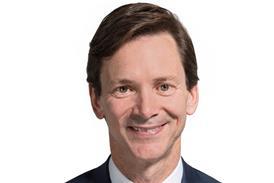













Airbus believes it can play a central role in a stronger, more consolidated European defence market, with chief executive Guillaume Faury reiterating the manufacturer’s commitment to the Franco-German Future Combat Air System (FCAS) while conceding “we would support a two-fighter solution” – a reference to the rival Global Combat Air Programme partnership between Italy, Japan and the UK.
Commercial aircraft activities continue to dominate at Airbus, but Defence and Space remains a strong second string, with Airbus on 19 February reporting revenue for the division up 11% year-on-year to €13.4 billion ($15.8 billion). Faury acknowledges the “transformation” of the business over the past year, with a record order intake on the back of rising defence spending in Europe and elsewhere.
“Airbus can play a leading role in securing European sovereignty,” says Faury, adding that further consolidation among both suppliers and customers is essential to achieve a critical mass to be competitive against US industry. “When we work at scale in Europe, we are very strong, but when we are fragmented it is harder,” he says.
An increase in defence spending in Europe is being accompanied by a drive to procure more from home-grown suppliers, says Faury, adding: “As the largest European defence player, we have capabilities that align with needs.” He predicts Airbus’s defence business – which represents roughly a fifth of the company’s revenue – will grow at the same speed as the commercial side.
The first order for the MRTT+, the enhanced version of the A330 Multi Role Tanker Transport, from the Royal Thai Air Force, and an agreement from Turkey for 20 Eurofighter Typhoons – Airbus has a 46% share in the programme alongside BAE Systems and Leonardo – were among the 2025 highlights for the division.
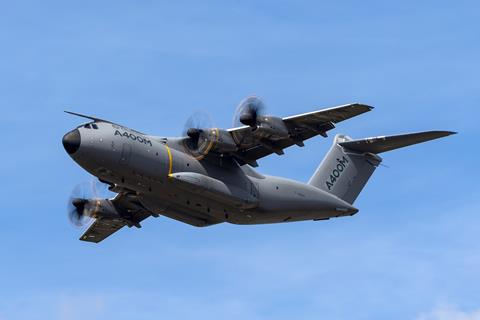
However, Airbus faces challenges with its flagship A400M programme as an initial wave of commitments from European launch customers approaches and amid limited export prospects. The company’s current backlog for the Europrop International TP400-powered military airlifter stands at under 50 aircraft.
Airbus’s relationship with its FCAS partner Dassault has become increasingly strained, with Eric Trappier, chief executive of the French defence manufacturer, stating last year that the consortium could not continue in its current form, with no clear industrial leader for the project.
Faury concedes FCAS is at “a difficult juncture” with “deadlock” over the sixth-generation fighter element. However, he says “the programme as a whole makes sense”, with Airbus continuing to progress in areas such as engine development and “combat cloud”. He adds: “The European need for a future combat system is unchanged and ambition on this scale can only be achieved through cooperation.”
In its results statement, Airbus highlights concern about the A400M’s future with a possible gap looming as deliveries for current contacts wind down before new commitments are secured. Airbus is currently producing eight units a year. “In light of uncertainties regarding the level of aircraft orders, Airbus continues to assess the potential impact on the programme’s manufacturing activities,” it says.
Despite a “competitive product”, a positive cash flow on the programme in 2025, “very strong feedback from operators”, and various ongoing sales efforts, Faury adds that “engaging in those campaigns takes time” and “timing becomes a challenge”.
He continues: “How long do we have to go on with assembly before a second wave [of orders]?” However, he says the fact that several European countries have identified strategic airlift as a procurement priority gives him hope.
When it comes to space, Faury says Airbus can “create a new leader in Europe” by consolidation. It is bidding to merge its space activities with those of Leonardo and Thales after signing a memorandum of understanding last October. The move, which aims “to strengthen Europe’s strategic autonomy in space” by pooling the companies’ non-launcher space businesses, must be approved by regulators.
In January, Airbus also secured a key contract from Eutelsat to build 340 OneWeb low Earth orbit (LEO) satellites, taking the total order from the French satellite operator to 440. The platforms will be built on a new production line at Airbus Defence and Space’s Toulouse facility, with deliveries beginning at the end of this year.