














Airbus Helicopters has expanded its footprint in the tactical uncrewed aerial system (UAS) sector, after integrating several products previously promoted by sister company Airbus Defence & Space.
Recently concluded, the organisational transfer has brought a trio of new systems under Airbus Helicopters’ control: the Survey Copter-developed fixed-wing Aliaca and Capa-X platforms, and the vertical take-off and landing (VTOL) Flexrotor. These now sit beneath its VSR700: an uncrewed development of the Guimbal Cabri G2 light helicopter.
“The objective is to have a single interface for our customers when they want to talk about tactical drones, because most of them can be complementary,” Victor Gerin-Roze, Airbus Helicopters’ head of UAS programmes, told journalists at its Marignane production site near Marseille on 14 October.
With a maximum take-off weight (MTOW) of 25kg (55lb), including an intelligence, surveillance and reconnaissance (ISR) payload totalling up to 3kg, the Aliaca vehicle is currently being adapted to add a VTOL capability.

The 120kg MTOW VTOL Capa-X, which can carry a 20kg ISR or cargo payload, is on track to enter service with the French navy “very soon”, Gerin-Roze says.
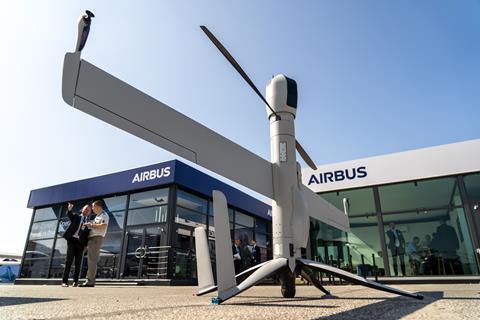
The tail-sitting Flexrotor, meanwhile, is a 25kg-class platform with an 8kg payload capacity. One system – comprising three air vehicles and a ground control station – was deployed aboard a German navy frigate during NATO’s recent REPMUS exercise.
Newly powered by a Pratt & Whitney Canada PT6 heavy-fuel engine for the maritime deployment, the Flexrotors accumulated more than 50 flight hours as part of the activity, including one sortie of over 10h.
Airbus Helicopters also has conducted recent development work to add pod-housed guided rockets to its VSR700, but has no current plans for a firing campaign. It also is proposing to equip the roughly 750kg MTOW platform with a maritime search radar and the ability to deploy light sonobuoys.

“We already have different versions, which allow us to transform this into a multi-mission platform that can be used by the armed forces,” he says. “This is a perfect example of a drone which will be developed for dull, dirty and dangerous missions.”
The company cites an operating endurance of 8h for the type while carrying a 100kg load, but the design is able to lift more than 150kg.
Paris in June 2025 selected the VSR700 for its navy’s SDAM requirement, which seeks an uncrewed VTOL system for use aboard its frigates. “We are discussing about taking the first order” Gerin-Roze says of ongoing contract talks with France’s DGA defence procurement agency.
In addition to expanding the company’s product line, Airbus Helicopters chief executive Bruno Even says its boosted UAS offering “will also accelerate the cooperation between drones and helicopters thanks to our HTeaming solution”.
That crewed/uncrewed teaming – or CUC-T – capability is planned for integration across its range of military rotorcraft.
Earlier this year, the company took part in a demonstration for the Spanish navy which combined operations of an H135 helicopter with a Flexrotor UAS. And at the Paris air show in June, it announced that it will conduct a similar CUC-T trial with the Flexrotor for H225M customer Singapore.
More recently, one of the Spanish army’s NH Industries (NHI) NH90 transport helicopters trialled the launch of an Arquimea Q-Slam-40 UAS. Performed in late September, that involved a tube-stored example – mounted vertically inside the rotorcraft’s cabin – being dropped through a floor-hatch which is ordinarily used to monitor cargo-hook operations.
Such a vehicle could be employed from the helicopter for ISR duties, or to act as a loitering battlefield munition.
Also speaking in Marignane, NHI president Axel Aloccio said a similar trial will be performed in France early next year. He notes that the NH90 could in the future also could be used to deploy air-launched effects (ALEs) and larger unmanned systems if equipped with a heavy stores carrier wing.
Gerin-Roze says the next step on the CUC-T journey will be to demonstrate the ability for a crew member to task an unmanned vehicle by using a tablet controller, with that work – scheduled for 2026 – to also involve a safety pilot.
Within a further two to three years, Airbus Helicopters wants to have an integrated solution which will enable pilots to manage operations with multiple deployed UAS or ALEs.
Meanwhile, Airbus Helicopters continues to eye the US Marine Corps’ requirement to field an aerial logistics connector platform, for which it is proposing an uncrewed derivative of the US Army’s H145-based UH-72B Lakota. An autonomous version of the light-twin would be able to transport a cargo load of up to 2t.
Notably, following the departure of its lightweight tactical UAS portfolio, Airbus Defence & Space remains responsible for the Eurodrone medium-altitude, long-endurance system – in development for France, Germany, Italy and Spain – and the Airbus Spain-developed SIRTAP vehicle.