












Airbus Helicopters hopes to confirm additional orders for its H145M before the end of 2025, as it continues work to bring further capabilities onto the military light-twin.
“We have some new requirements coming from the market,” says Constance Pinsdorf, head of the H145M programme. She adds that since the start of the war in Ukraine in 2022, “we couldn’t answer enough questions regarding military capabilities”.
“We have so many requirements and questions coming from the customers. I have many ongoing parallel negotiations,” Pinsdorf tells FlightGlobal.
“We hope that another big European partner will sign a contract with us in the coming months,” she says.
The company’s recent customer list for the H145M includes Belgium, Brunei, Germany and Ireland, and it is in a production ramp-up phase to keep pace with demand.
“Everything that is now under negotiation, I am feeling confident that we can handle it, because we have already blocked all the [production] slots for the next few years,” Pinsdorf says.
Spain on 24 September approved a major spending programme which will include the purchase of 54 new light-twin rotorcraft, without disclosing the type involved.
The military model’s open architecture mission system design means the airframer can integrate a variety of new equipment beyond its “mature baseline”, she adds.
Examples include variable message format and Link 16 datalinks, secure communications equipment, and air-launched weapons integrated using its HForce system.
Work to fully integrate Rafael’s Spike ER2 long-range air-to-surface missile continues. “The Spike qualification phase is in a good way,” Pinsdorf says. “We did our firing campaign, it was done successfully, and now we have to do the last steps.”
Meanwhile, having first demonstrated the platform’s ability to perform manned-unmanned teaming operations in 2022, Airbus Helicopters is now exploring the addition of air-launched effects (ALE).
“We have a research contract in place,” Pinsdorf says. A first phase of ground-testing is due to start later this year, ahead of demonstration flights scheduled during 2026.
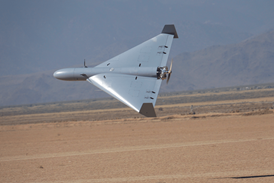
Due to run over an 18- to 24-month period, the activity will involve Anduril’s Altius 600, although other systems – potentially such as the UVision Hero 120 – could be integrated in the future if requested by a customer.
“Drone use is accelerating, but if you are using a weapon it is very important that there is a human in the loop,” she notes. “For us, the philosophy is always that we have a two crew-member concept.”
However, “For the long term, it is definitely important for us that we have a closer look at uncrewed helicopters. This is a cooperation which is done with our American partners,” she adds, referring to “AHI [Airbus Helicopters Inc], L3Harris or Shield AI”.
“The US Marine Corps is the driving factor. They are interested in having a logistical connector.” Such a capability could be in use before 2030.
Airbus Helicopters’ candidate will be derived from the H145M D3 model, with a five-bladed main rotor.
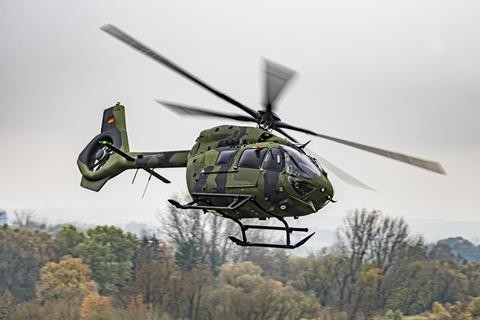
The company’s current largest commitment for the type is from Germany, which took delivery of its first of up to 82 light combat helicopter (LKH)-programme examples last November. Berlin has signed for 62 examples, and has options on another 20.
Noting that the departing Airbus Helicopters Tiger is “a real attack helicopter”, Pinsdorf adds: “the H145M is not a replacement: it is a multi-mission helicopter.”
The German military “must operate the helicopter in a different way” to the Tiger, she notes, since the LKH model’s electro-optical/infrared sensor is installed beneath the nose, rather than on a mast above its main rotors.
Armed examples will be equipped with missile, radar and laser warning systems, and have a chaff and flare countermeasures fit for self-protection.
But for Germany, she says: “Our biggest benefit is we can change our role within one hour from a light-attack version to search and rescue, VIP, troop transport, or a training helicopter.”
In addition to its progress on the major deal for Berlin, Brunei also is due to receive its first of six H145Ms before the end of next year from Airbus Helicopters’ Donauworth production site in Germany.