












Lockheed Martin is confident that its C-130J is best placed to meet the Indian air force’s Medium Transport Aircraft (MTA) requirement, with the US company highlighting its existing relationship with the nation’s defence industrial base.
New Delhi’s MTA programme seeks a replacement for its aged Antonov An-32 and Ilyushin Il-76 transports. While a formal request for proposals (RFP) has yet to be issued, it is expected to acquire between 60 and 80 new airlifters.
With the Indian air force already flying 12 C-130J-30s in a variant optimised to support special operations forces, Lockheed argues that its offering is uniquely positioned for the MTA opportunity.
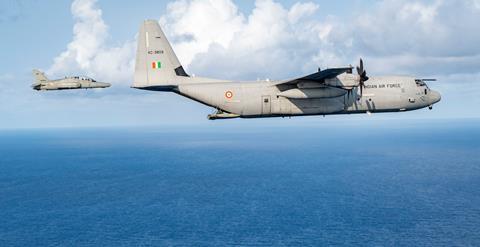
“The Indian air force has proven that the C-130J is ideally suited for the extreme, diverse topography of India, regardless of the missions that they have been tasked to do,” says Robert Toth, the company’s vice-president, business development and strategy, air mobility and maritime missions. “They’ve proven that the C-130J is the right aircraft for India’s very challenging environment.”
The potentially 80-aircraft opportunity would represent the biggest-ever export sale of the C-130 in the programme’s more than 70-year history. And uniquely, it would lead to the Hercules being produced overseas for the first time.
If selected, Lockheed would complete assembly of a portion of the Indian fleet in the USA at its Marietta plant in Georgia, with work on the remaining aircraft to transition to a new facility in India. Its location would be selected according to the wishes of the Indian government.

“We would establish that facility in India while we maintain full-rate production in Marietta” for other customers, Toth says. Its current output is scaled to deliver between 20 and 24 of the tactical transports per year, although this could be increased if New Delhi wishes to field its new capability rapidly.
Lockheed’s joint venture (JV) with Tata Advanced Systems (TASL) recently handed over its 250th Indian-produced empennage for the C-130J from Hyderabad.
“They are hitting 100% on-time deliveries, and the quality is perfect,” Toth notes. “The workforce that they have built is amazing to see.”
The site also is under contract to produce 29 wing sets for Lockheed’s F-16 fighter programme.
The partners recently announced that they are jointly investing to stand up an in-country maintenance, repair and overhaul (MRO) facility for the C-130J, with a ground-breaking ceremony performed at a site in Bengaluru.
“That MRO facility will initially support the 12 in-service C-130Js, with the first induction planned for 2027,” Toth says. “The growth plan is to support up to 80 aircraft for the MTA programme – there is a significant opportunity to out get ahead of MTA,” he tells FlightGlobal.
In addition to its JV on C-130J manufacturing, Lockheed’s Sikorsky subsidiary also has a similar presence related to the UH-60 Black Hawk programme, established in Hyderabad around 15 years ago. “These two joint ventures are widely recognised for jump-starting India’s aerospace defence capability,” Toth claims.
“What really matters is past performance and capability that’s ready today,” he asserts. “India can leverage the infrastructure that it already has in place, and its operational experience.
“We are uniquely positioned to deliver on the Buy/Make requirement,” he says. “We are ready to deliver airplanes today – faster than any of our competitors.”
Toth also notes that TASL has been highly successful in delivering the in-country production element of another major aerospace programme – a reference to the Indian air force’s acquisition of 56 Airbus Defence & Space C295 medium transports.
“We believe that the AoN [acceptance of necessity] will be [approved] some time at the beginning of 2026, and shortly afterwards there will be the release of the RFP,” he says of the likely programme timeline.
Other contenders for the MTA requirement include the Airbus Defence & Space A400M and Embraer C-390, with Russia also understood to be pitching an undisclosed model.
While none of those platforms can match the payload capacity of the Il-76, Toth notes that the Indian air force is an existing operator of Boeing’s C-17 strategic transport, enabling it to already meet requirements to carry outsized cargo.
Meanwhile, he notes that Lockheed has secured export contracts from two nations during 2025 to field J-model Hercules.
In September, Mexico announced that it had ordered a single example for air force use. The service already has two C-130Ks and a lone commercial-variant L-100 in operation, fleets data from aviation analytics company Cirium shows.
Toth says Lockheed thinks Mexico will in time bolster its J-model fleet, noting: “we believe the final objective is four to six aircraft”.
The company’s other recent buyer – an undisclosed customer for three C-130Js – has never previously operated the Hercules, he notes.
Meanwhile, Lockheed is exploring a broad range of future enhancements for the C-130J, with Toth identifying potential updates as including open-architecture avionics, autonomy functions and enhanced connectivity.