
















L3Harris has launched low-rate initial production (LRIP) of its Viper Shield electronic warfare (EW) suite for the Lockheed Martin F-16, after the technology cleared a key review conducted by the US Air Force (USAF).
Announcing the development on 14 November, the US company said the recently completed production readiness review evaluated aspects including “design integrity, manufacturing processes, quality assurance protocols and supply chain logistics”.
Designated the ALQ-254, the Viper Shield system will be integrated with Lockheed’s current production-standard Block 70/72 F-16 for Foreign Military Sales (FMS) customers Bahrain, Bulgaria, Jordan, Morocco, Slovakia and Taiwan.
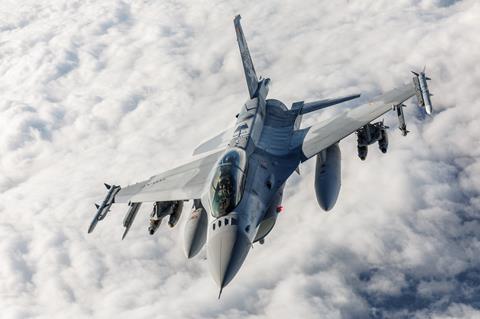
In late August, Poland became the first customer to contract L3Harris to upgrade the capabilities of its older-model F-16C/Ds, as part of a broader capability upgrade for its 47-strong fleet.
Once combined, the commitments from those seven nations totals 219 Viper Shield systems.
“We now have hardware rolling off the line that has been checked and certified for our customers,” Travis Ruhl, director of international business development, electronic warfare, airborne combat systems, told FlightGlobal at the Dubai air show on 18 November.
Now having entered LRIP, L3Harris will rapidly scale-up its activities, with full-rate production – at an undisclosed rate – due to be reached during the first quarter of 2026. This means the technology will be “ready to meet the 2027 [operational] challenge”, the company says.
Meanwhile, it also is close to confirming the first buyer for a pod-housed version of the system, which was displayed as a half-scale model on its stand at the Dubai show.
“We expect in the near-term to be able to announce the lead F-16 pod Viper Shield customer,” says Ruhl, who indicates that this will occur during 2026.
“We have got the first article of the pod assembled in a lab, which is really going to buy down risk for those that decide that the pod is the right option for them,” he adds.
“The RWR [radar warning receiver] and ECM [electronic countermeasures] functions are identical to what you would have on the internal system,” Ruhl notes.
“It has the same advanced threat environment and self-protection jamming that allows this to be electronic armour, but is perhaps a little bit more affordable,” he says. This is because a customer could choose to buy pods for perhaps half of its F-16s and then move them around the fleet as needed.
With its equipment drawing close to being integrated with jets for FMS customers, L3Harris is urging the USAF to also consider making an acquisition of Viper Shield, to boost the capability of its active-duty and guard-operated F-16 fleet.
“It would be a shame to not leverage the investment that our partners have made to build this advanced EW system,” Ruhl says, noting that the technology would fit all USAF F-16s as either an internal or podded solution.
Pointing out that the service intends to continue operating its Block 50-version F-16s through 2040, he says: “It makes the platform more survivable, so you can push it further forward and fill the operational need.
“It really is the perfect moment… to provide a solution to the warfighter,” he states. “It is the only advanced EW system that is in production today for the F-16. We are the leading edge.”