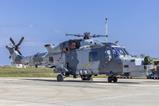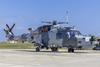














NH Industries (NHI) is on track to deliver the German navy’s first Sea Tiger-variant example of the NH90 helicopter before year-end.
Development flights of the maritime NFH-derivative were conducted throughout 2024, and Berlin signed off qualification of the new version at the end of July.
“Now we are just finalising the remaining bits and pieces in production to deliver the first helicopters by the end of the year,” says NHI president Axel Aloccio. “The remaining ones will be delivered over the next five to six years,” he adds.
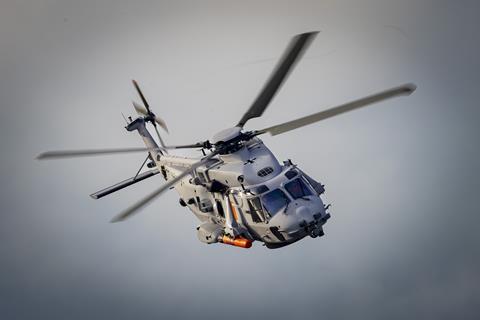
The German navy will field a total of 31 Sea Tigers, with the model to join its already-operational Sea Lion variant, which is optimised for search and rescue duties.
Another new version of the NH90 also will begin being delivered next year, with the French army to take its first of 18 examples in a Standard 2 special operations configuration. Shipments from NHI consortium member Airbus Helicopters’ Marignane final assembly site near Marseille are due to commence in June 2026.
“The flights are finished, and now we are in the phase where we have to supply all the qualification evidence to our authorities. We expect the qualification to be announced [in] Q1 of next year,” Aloccio says. He describes Standard 2 as being the “latest and greatest” version yet of the twin-engined type.
NHI also is poised to later this month deliver the last of 20 NH90 troop transport helicopters (TTHs) on order for the Greek army.
Athens still has no support contract in place for the type, which has resulted in nine of its NH90s being cannibalised for spare parts – to the extent that they would need to undergo remanufacturing to be returned to use.
“We have discussed a first contract for follow-on support,” Aloccio told reporters in Marignane on 14 October. “This is in the last steps of validation, so we are waiting now for the final decision.”
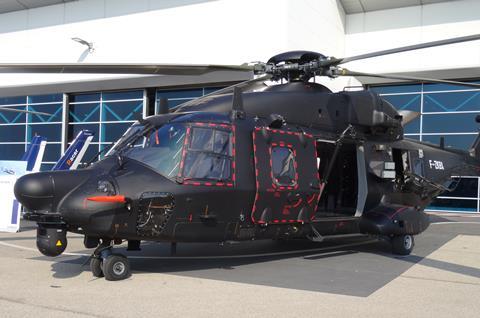
Meanwhile, NHI will finalise study work later this year on a proposed HSPN model for the Spanish navy, which Aloccio says will be “largely inspired by the [German] Sea Tiger, but with some Spanish specificities”.
Madrid recently also indicated an intention to procure a further batch of 32 TTHs for its army, potentially in an armed configuration. The service already has 14 NH90s in use, with another 10 already on order.
“We are in the middle of commercial discussions with Spain for batch 3, and we are going to deliver an offer in the next days,” he says.
Once confirmed, the new Spanish deals will boost the NHI partners’ firm order backlog beyond around 80 units currently. The Netherlands – which has already fielded 19 TTHs – also could be set to order additional examples, Aloccio believes.
“We hope to sign one or two contracts at the end of this year or in early 2026,” he adds, without providing further details.
NHI has delivered 530 NH90s to date, with the global fleet on course to pass a combined 500,000 flying hours during 2026.
Addressing the Belgian air force’s recent withdrawal from use of its four transport-model NH90s, Aloccio says: “I think the issue with the [Belgian] TTH is the number – it was too small”, since only two would typically be operational. “It’s 12 or 18 that you would have needed to really have a meaningful operation,” he argues.
Brussels will, however, continue to operate its four frigate-based NFH-version NH90s, and discussions continue around whether its TTH assets could continue to fly in cooperation with the French army.
Meanwhile, Aloccio says progress continues to be made with improving the provision of in-service support for the NH90: an issue which has hampered operators in the past.
Among the measures to have been adopted by NHI to improve its provision of MRO services was its acquisition of Australia’s retired NH90s, which Aloccio says “are now parts”.
NHI acquired around 4,000 parts from Australia, with one-quarter of this total having so far been “revalidated” for use. More than 200 of those parts have been sold to operators or used within the consortium’s “standard exchange” support mechanism, he says, while adding: “Some customers are now telling us that parts are no longer an issue.”
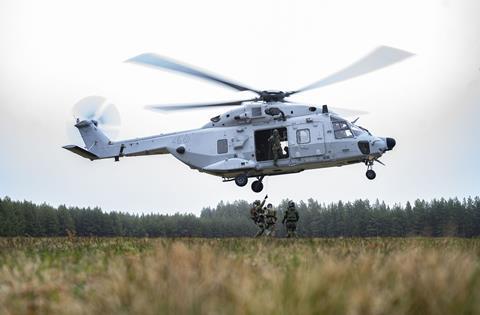
Sweden has previously suggested that it might end operations with the NH90, but he notes that the nation’s 18 examples remain in use, with no final decision about their fate having yet been communicated.
“They are very happy with the performance they are getting from the NH90, in particular the version with the dipping sonar, which they use intensively in the Baltic Sea to hunt for Russian submarines,” he says.
A fleet-wide retrofit activity was completed earlier this year, and accompanying measures including improved supply chain performance and a new support initiative has been established involving Finnish company Patria. These steps mean that “In the last two years they have increased their flight hours by 60% – they are getting a lot more out of their fleet.”
He notes: “This process of ‘what do I do with my NH90s’ was launched based on a past situation, which was difficult, but which has been solved since then. The situation has completely changed.”
Separately, the German army is preparing to deploy around 25-30 of its TTH-model rotorcraft to Lithuania, in support of a multinational effort to strengthen NATO’s eastern flank. The service has just over 80 examples of the type in current use.