
















Faced with continued uncertainty over the USA’s long-term commitment to the Boeing E-7 Wedgetail programme, a group of NATO members has ditched plans to acquire the airborne early warning and control jet.
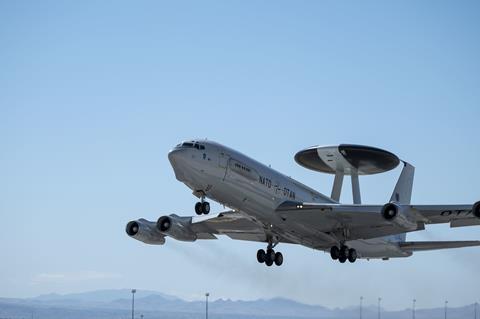
Intended as a replacement for a pooled fleet of 14 Boeing E-3 AWACS aircraft which are due to be retired by 2035, NATO planned to acquire six E-7s through its Alliance Future Surveillance and Control (AFSC) programme.
Announcing the decision to abandon the E-7 buy, the Dutch defence ministry – one of seven European NATO members in the programme – says the USA’s withdrawal from the programme in July had removed the “strategic and financial basis” for the acquisition.
“The members are now exploring alternatives for replacing the fleet and are looking for new partners,” it says.
Participating nations include Belgium, Denmark, Germany, Luxembourg, the Netherlands, Norway and Romania.
European solutions for the pooled fleet are now likely to sought. Saab had previously proposed its Bombardier Global 6500-based GlobalEye platform for the requirement.
The US Air Force (USAF) had originally planned to acquire 26 Wedgetails, but the service’s 2026 budget request in June axed funding for the programme due to survivability concerns in favour of space-based surveillance solutions and additional Northrop Grumman E-2D Hawkeyes.
Although an additional $200 million funding for rapid prototyping of the E-7 was contained in the recent spending resolution to end the US government shutdown, it is unclear what the long-term impact of this will be.
An initial two prototype Wedgetails are due to be delivered to the USAF under a $2.6 billion contract.