










South Korean government ministries have formed a consultative body that will help guide Seoul’s quest to develop an advanced fighter engine.
The “Inter-Ministerial Consultative Body” will review development plans for South Korea’s planned indigenous fighter engine, says the Defense Acquisition Program Administration (DAPA).
The body will coordinate ministerial efforts related to engine technology, with an eye to preventing the duplication of investment among ministries.
The body includes the Ministry of Trade, Industry and Energy, the Ministry of Land, Infrastructure and Transport, and the Ministry of National Defense, as well as other parties.
DAPA notes that few countries possess advanced engine technology. By developing an advanced engine locally, South Korea will save on the maintenance, repair and overhaul costs attached to engines from other countries.
Moreover, an indigenous engine will support South Korea’s efforts to export military aircraft.
In 2023 DAPA committed to the development of a fighter engine. It will be ready by the late 2030s and feature a non-afterburner thrust of 15,000lb (66.8kN). The engine will power Block 3 examples of the Korea Aerospace Industries (KAI) KF-21 fighter.
The key company involved in South Korea’s engine efforts is Hanwha Aerospace, which has a long history of building fighter engines under licence. These include the F414 – which will power Block 1 and 2 versions of the KF-21 – and the F404, which powers KAI’s T-50/FA-50 family.
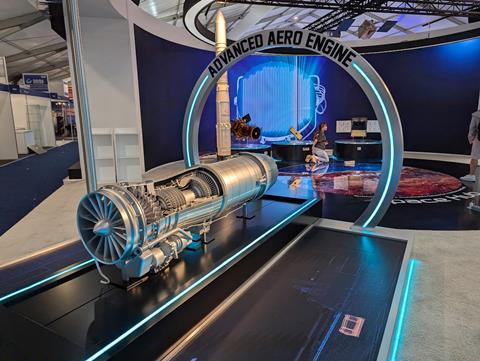
At the Farnborough air show in July 2024, Hanwha showed a model of its Advanced Aero Engine. A company executive said that the engine could be modified for other uses, such as South Korea’s prospective Next Generation Transport Aircraft, as well as naval vessels.
The formation of the ministry-level body follows DAPA’s formation of an “Advanced Technology Project Management Committee” in January. This committee has been working with ministries to consolidate capabilities in areas such as testing infrastructure, parts, and materials.
“Advanced aircraft engines are a strategic technology with significant ripple effects beyond the military to the civilian sector,” says Jeong Jay-jun, acting director of DAPA’s Advanced Technology Division.
“Therefore, we must work closely with each ministry to revitalise the industrial ecosystem and expand into civilian engine development in the future.”