
















The first test firing of a low-cost cruise missile candidate for the UK Ministry of Defence’s (MoD’s) Brakestop programme has been conducted.
Initiated late last year, the Brakestop effort has attracted interest from 27 companies to design, build and test a ground-launched, long-range one-way effector.
Speaking to the House of Commons’ Defence Committee during a 16 December session, Lieutenant General Anna-Lee Reilly, director general core delivery at the UK’s Defence Equipment & Support organisation, revealed that the first test firing had taken place the previous day.

Reilly says the Brakestop programme has a set of “five incredibly simple requirements: on range, payload, cost, production quantities, and can you transport it in an ISO [shipping] container”.
According to an overview published in September 2024, performance requirements included the ability to deliver a 200-300kg (441-661lb)-class payload over a target range of 324nm (600km) at a speed of around 324kt (600km/h). Per-round unit cost should be around £400,000 ($537,000).
“The idea is you buy, you try and you scale,” Reilly says. “We have the ability of being able to do that trialling in the UK and then taking it out to Ukraine,” she adds.
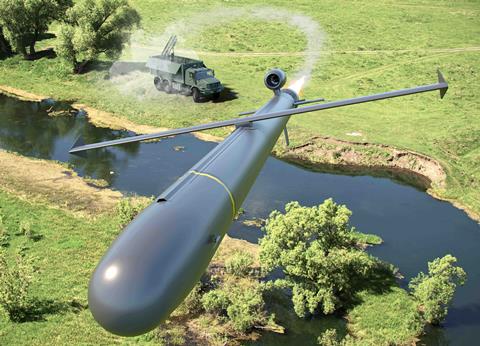
The company involved in the 15 December test firing has not been disclosed. The requirement has attracted interest from a range of traditional and start-up contractors, including the likes of MBDA and MGI Engineering. The companies respectively promoted their Crossbow design and TigerShark candidate at the DSEI exhibition in London in mid-September.
Meanwhile, National Armaments Director Rupert Pearce told the committee that the UK’s new Defence Investment Plan (DIP) remains in preparation ahead of its delayed release.
“The DIP is in its final stages, and we will bring it out as soon as it’s done,” he says. Referring to it as a “very complicated, multi-dimensional document”, he adds: “I’d rather do it slightly late than wrong.
“We are talking about days now, not weeks or months,” he adds.
The UK government had previously indicated that work on the strategic planning document would be completed “this autumn”.