










Airbus believes it will be able to offer a choice of engine suppliers on its Next Generation Single Aisle, even if it opts for open-fan powerplants on the new narrowbody.

Among the propulsion manufacturers, only CFM International – a joint venture between Safran Aircraft Engines and GE Aerospace – has so far opted for an open-fan design and is validating the architecture through its RISE technology demonstrator programme.

ONERA Safran

Source: Safran

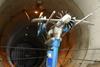
CFM has already performed windtunnel testing on one-fifth-scale open-fan engine

Airbus will test the RISE engine aboard its A380 in 2028, and while it insists no decision has been made on engine architecture or supplier, it views the fuel-efficiency benefits of the open-rotor as extremely promising.

But Frank Haselbach, Airbus senior vice-president, head of propulsion engineering, thinks more will follow CFM’s lead.

“If you change the paradigm, if you change the architecture of the product so much that it is actually competitively overwhelming, the industry will follow and choice will come again and we will be back into the old [dual-source] system,” he said on a 6 November Financial Times webinar sponsored by CFM.

Airbus offers a choice between the CFM Leap-1A and the Pratt & Whitney PW1100G on its A320neo-family jets, continuing a model seen on the preceding Ceo variant which was offered with either CFM56s or International Aero Engines V2500s.

P&W is seemingly set on pitching a next-generation version of its ducted geared turbofan for the NGSA, but due to the substantial integration differences between the competing engine architectures, repeating the previous dual-source model appears impossible.

Arjan Hegeman, vice-president of future flight at GE, is also adamant that others will follow suit: “This is a revolutionary engine and when we prove the merits, the value proposition that this architecture brings, I’m convinced we will not be the only ones working on open-fan technologies for next-generation products.

“There’s no reason why it would have to be single source: just like today you can dual source a ducted engine, tomorrow you can dual source an unducted engine.”

In addition to P&W, Rolls-Royce is also pursuing a next-generation ducted engine through its planned narrowbody-sized UltraFan 30 demonstrator.

While CFM has always insisted the technologies matured through the RISE programme such as advanced high-temperature materials and hybrid-electric systems could be applied to a more conventional design if required, Hegeman insists it has no plans to pursue an alternative engine: “We are all in on open-fan,” he says.

But in addition to developing the powerplant itself there are significant challenges to be overcome, including noise and shielding the fuselage from blade release – functions currently performed by the engine cowl.

Pierre Cottenceau, vice-president, engineering, research & technology Safran Aircraft Engines, is confident these issues can be resolved.

He point out taht the large 4m (13ft)-diameter fan “rotates relatively slowly… which means less energy” should a blade detach.

“With this lower energy we can accommodate the remaining debris with the fuselage improvement,” he says.

“We are also putting more focus on making it less likely to have a fan blade release,” adds Haselbach.

Simulations performed by CFM are also providing confidence that the open-fan design can be quieter than current-generation engines.

“We have seen there is the possibility to get the right balance to be capable of meeting future noise requirements with this open-fan without having additional room for noise management in the cowl,” says Haselbach.

Describing this as a “real breakthrough” he says the next step will be to conduct an integrated test with an aircraft wing “to see that the fundamental simulation we now have of the integration holds true”.

Airbus is still analysing two different installations of the open-fan engine: a traditional wing-mounted configuration and a rear fuselage-mounted layout.

Haselbach says the wing-mounted design is its preferred option as it “has a lot of advantages for a family concept of aircraft” and offers “slightly better handling qualities”.