


















Pratt & Whitney continues to insist its engine offering for the next generation of single-aisle aircraft will be a traditional ducted fan engine, eschewing the open-fan design of its rival CFM International.
Rick Deurloo, president, Pratt & Whitney commercial engines, says the company is “100% committed to the geared architecture” and “to our traditional installation of the engine”.
“What drives us away [from the open-rotor] is our absolute confidence in the geared turbofan architecture and what we study and understand and bring when we look at the next-generation technology,” he said, speaking at a pre-Dubai air show press briefing on 16 November.
“We think that ultimately that geared architecture, along with advanced technologies, with traditional installation, will be the platform of choice.”
CFM has been highly vocal about the potential fuel-burn saving offered through the unducted open-fan architecture, which it believes to be greater than that available from a ducted design.
P&W has also done its own research into the technology, even filing a string of related patents – the most recent earlier this year.
However, P&W maintains it has no interest in pressing ahead with an open-rotor engine: “Based on our research, we concluded that the installation, integration, noise and industrial challenges associated with an open-rotor architecture would increase the overall executional risk,” it says.
Deurloo says P&W is looking at a range of next-generation technology for the engine, including heat-resistant ceramic-matrix composites and carbonfibre fan blades, adding: “We think the opportunities are fantastic here.”
Development of the new engine – which will feature higher pressure and bypass ratios than the current-generation GTF – will be led by P&W and its existing partners within the International Aero Engines (IAE) consortium MTU Aero Engines and Japan Aero Engine Corporation (JAEC).
Following a board meeting on 13 November, the IAE partners announced they had reaffirmed “their commitment to the consortium partnership”.
But Deurloo says that “does not exclude” the potential future inclusion of another partner.
While Rolls-Royce – an original member of IAE until its exit in 2012 – is the obvious candidate, he also points to others in the sector including ITP Aero and GKN Aerospace but stresses that “we have not advanced any of those conversations beyond JAEC and MTU today”.
“We are committed to next-gen single-aisle and to our partnership we have in place today. Do we talk to all kinds of different partner opportunities? Of course. But right now, we’ve announced who our partners are and that’s MTU and JAEC on next-gen single-aisle.”
But Deurloo says whether it will be an IAE or P&W product is “still up for debate”. The current PW1000G-series of engines is “Pratt & Whitney labelled” but built by the “IAE venture”.
Both scenarios are options for the future but Deurloo says it “too early to speculate on what it will be”.
The question of timing also remains a source of speculation. Of the big two airframers, only Airbus has disclosed a roadmap towards a future narrowbody through its Next Generation Single-Aisle effort to replace the A320neo family. This is set to arrive in the second half of the 2030s.
However, Deurloo thinks the industry will prioritise stability on its current generation of products, pushing a new narrowbody “more towards the right”.
“I lean more towards that way – [20]38 to ‘40 seems more like a logical time to me,” he says, but stresses P&W will be “ready whenever it is”.
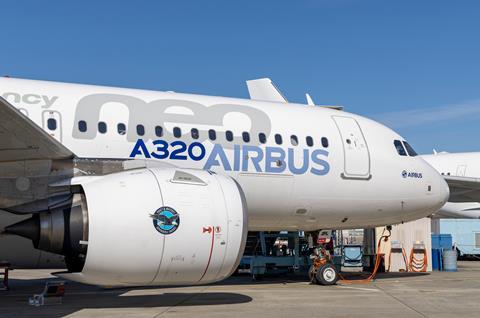
In the nearer term, P&W remains in negotiations with Airbus over future production rates on the A320neo line where its PW1100G competes against the CFM Leap-1A.
At present, it has an agreement to support production of 63 aircraft per month, albeit the PW1100G’s share on the A320neo is under 50%.
Airbus does not publicly disclose its production rates on a monthly basis but based on recent delivery numbers, it is achieving output of around 60 aircraft per month.
“We are having conversations with Airbus. We are locking down their ’26 [deliveries], we’re locking down our ’26,” says Deurloo.