














China is aggressively expanding its ability to assemble and deliver new tactical military aircraft, including hundreds of the latest stealth fighters.
That is the conclusion of a research analyst in Washington, DC, who used commercially available satellite imagery to track activity at several key hubs for China’s state-owned aerospace conglomerate – the Aviation Industry Corporation of China or AVIC.
“China’s inventory of fighter and attack aircraft is going to grow significantly over the next five years,” says J Michael Dahm, a senior fellow at the Mitchell Institute for Aerospace Studies.
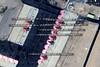
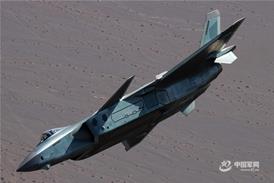
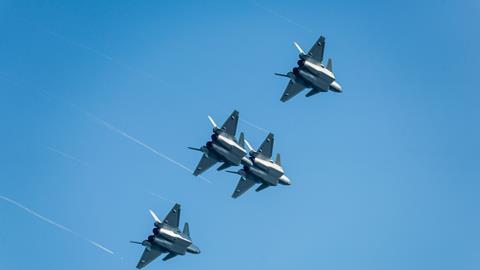
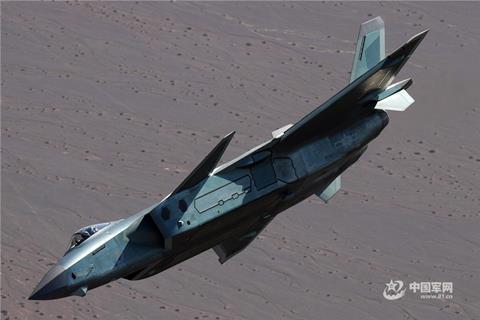
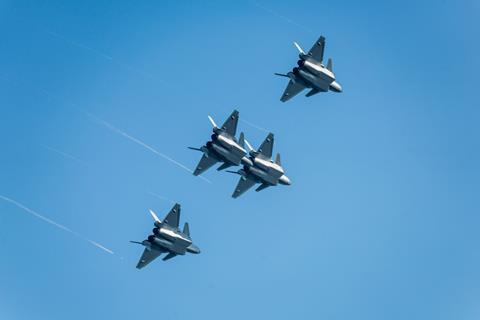
Since 2021, Dahm says AVIC has added some 278,700sq m (3 million sq ft) of manufacturing space at the Chengdu plant that assembles China’s fifth-generation J-20 air superiority fighter. Five J-20 production lines are now active at that facility.
The twin-engined, canard-winged fighter is viewed as China’s domestic attempt to match the American Lockheed Martin F-22.
“Looking back at commercial satellite imagery and substantial infrastructure improvements support the assessment that the Chengdu plant has increased its capacity and could be producing as many as 100 J-20s per year,” says Dahm, who presented his findings at the 2026 Air & Space Forces Association’s recent Warfare Symposium in February.
Other estimates, including one by the Royal United Services Institute, put China’s 2025 J-20 production figure at 120 aircraft.
Dahm’s analysis used images provided by the American firm Planet Labs, one of three major providers of commercial satellite imagery. Although also used for scientific and civil industry purposes, the availability of a high-resolution, unclassified orbital reconnaissance capability is reshaping military and intelligence operations.
The US government published commercially sourced satellite imagery of Russia’s troop build-up around Ukraine in late 2021 and early 2022 – something that would never have been done with photos taken by Washington’s government-owned reconnaissance satellites, owing to concerns about keeping the technical capabilities of those assets secret.
Last month, a private firm with connections to the Chinese government publicly shared commercial satellite images showing the location of US military assets around the Middle East, demonstrating the power of orbiting platforms to provide updates on troop movements in nearly real time.
Using those same tools, Dahm has been examining activity at aircraft production and test sites around China over the past few years.
Similar to the recent expansion at the Chengdu plant, other AVIC locations also show signs of growth. That includes the development of a new factory in Shenyang, which geospatial analysis suggest will include over 370,000sq m of manufacturing space and a dedicated 3,660m (12,000ft)-long runway.
This site, it is hypothesised, will assemble the new Shenyang J-35 and J-35A fifth-generation fighters – China’s answer to the American Lockheed Martin F-35 stealth fighter – respectively for the People’s Liberation Army Navy and People’s Liberation Army Air Force.
A separate 93,000sq m expansion is underway at the Changhe Aircraft Industries plant that assembles military helicopters, including attack and heavy-lift transport varieties. That represents a 30% increase in capacity.
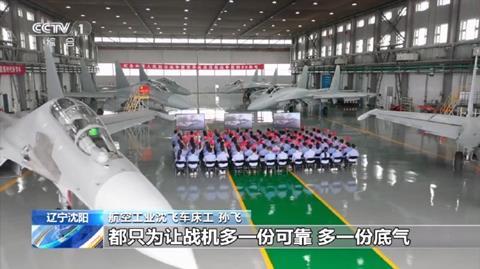
Between the three sites in Chengdu, Shenyang and Changhe, AVIC is adding more than 743,000sq m (8 million sq ft) of space, presumably to support additional aircraft production.
“Those 8 million sq ft are more than the entire F-35 manufacturing complex in Fort Worth, Texas,” Dahm says.
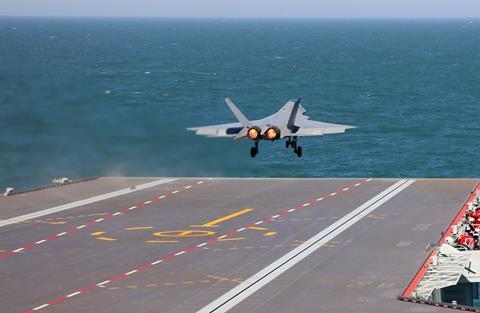
Meanwhile, the existing AVIC assembly line in Shenyang is continuing to deliver fourth-generation models, including the J-15 and J-16 fighters.
“Starting next year AVIC will have the capacity to produce 300-400 fourth- and fifth-generation fighters per year for the PLA,” Dahm says.
Beijing may not opt to make use of that full capacity, or could direct some portion of the output toward supporting export sales of its latest fighter types.
Regardless of the exact breakdown, Dahm predicts a minimum volume of at least 250 aircraft per year across AVIC’s entire fighter aircraft enterprise.
By contrast, Lockheed Martin is currently assembling F-35s at a rate of 156 jets per year, while the company’s F-16 Block 70/72 production line has a maximum capacity of 48 aircraft per year, with 16 examples delivered in both 2024 and 2025.
Boeing meanwhile is ramping toward producing its latest F-15EX at a rate of 24 jets per year.
In Europe, France’s Dassault Aviation delivered 26 Rafale fighters in 2025, with annual output of the type rising towards a target of 44.
While China seems to be taking the lead in raw output compared to the West, senior American figures say they still retain the advantage in terms of quality.
“I don’t believe, just sort of personally, that it’s equivalent to F-35,” Lockheed chief executive James Taiclet said of China’s J-20 during a January 2025 call with investors.
He also noted that Lockheed, which is the only Western company actively delivering fifth-generation fighter aircraft, still maintains an output edge with 156 F-35s assembled annually versus 100-120 J-20s from AVIC.
“We’re ahead of them,” Taiclet said.
That balance looks different, however, when including the new J-35 plant still under construction outside Shenyang and China’s existing capacity for fourth-generation fighters
And quantity has a quality all its own, as goes the famous axiom attributed to the Soviet Union’s military-industrial strategy during the Cold War.
If it makes full use of all that new production capacity, Dahm says China will have the largest fighter force on the planet by 2029. That comes as Beijing is also expanding its fleet of aircraft carriers and maturing its ability to conduct air operations from those naval vessels.
At the same time they are focused on generating mass, AVIC and the Chinese government are also pursuing qualitative advancements in new aircraft designs.
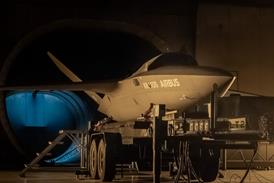
There have been multiple sightings of new tactical jets over the past two years, including a tailless, three-engined aircraft undergoing flight testing in Chengdu that has been unofficially designated the J-36.
A smaller, twin-engined type first seen over Shenyang in 2024 has been tentatively designated the J-50 or J-XDS. The distinctive jet, which is also tailless and appears to feature a thrust vectoring capability, reappeared again on 17 March in social media videos, presumably with the blessing of authorities in Beijing.
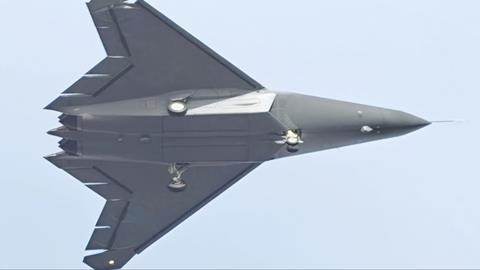
In 2025, US Air Force General Kenneth Wilsbach, who has since been promoted to be the service’s chief of staff, said the Pentagon believes the experimental Chinese jets are meant to fill an air superiority role.
That would make them loosely analogous to the Boeing F-47 sixth-generation currently under development for the US Air Force and the US Navy’s still-unnamed F/A-XX sixth-generation platform.
Signs of China accelerating its next-generation development programmes go beyond sightings of the new aircraft in flight.
Dahm says Planet Labs imagery shows that a remote air base in Xinjiang Province, which he refers to as “China’s Area 51”, has seen an additional 5,570sq m of hangar space and over 27,800sq m of facility space added in just the past year.
“China has effectively doubled the size of this remote testing base, which gives us some indication of where they might be going with test and evaluation and future aircraft development,” Dahm says.
In September 2025, commercial satellites captured the J-50 sitting uncovered on the ramp at the Xinjiang test base, exposed for the world to see.
That was no oversight, according to Dahm’s assessment.
“Someone is always watching from space. If there’s something they want you to see, something they want you to be talking about, they can maybe accidentally leave something out so that we’re talking about that instead of focusing on the big picture,” he says.
That big picture, he suggests, is the rapid expansion of both the new aircraft test site and factory production lines elsewhere in the country.
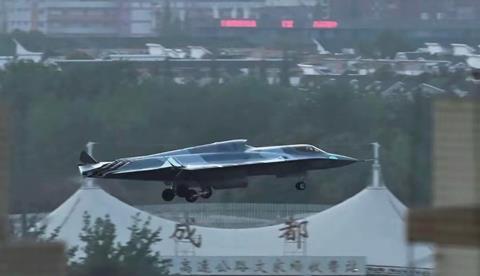
Dahm notes the latest satellite images indicate that around 20ha (50 acres) of land have been cleared on the north side of the current Chengdu plant, space previously occupied by Sichuan University. He posits that space could eventually be used to support production of a sixth-generation Chinese fighter or further expand J-20 capacity.
So what will China do with all that firepower?
The obvious answer is be ready to mount an operation to forcibly integrate Taiwan, whether via a protracted blockade or a cross-strait assault.
The famous 2027 “Davidson Window”, so-named for the former commander of US Indo-Pacific Command Admiral Philip Davidson, is rapidly approaching. That is the date by which the Pentagon claims Chinese premier Xi Jinping has ordered the PLA to be ready to seize Taiwan, should the order come.
In 2025, the current commander of INDOPACOM said Chinese forces are actively rehearsing for such a scenario.
It is not yet clear how recent purges of senior leaders in the People’s Liberation Army may have affected Beijing’s plans or the US assessment of Chinese activity.
Besides a Taiwan operation, Dahm predicts that Beijing might do what Washington does with its vast arsenal of combat jets and carriers: project power globally.
“We’re going to start seeing China’s air force in other parts of the world,” Dahm says. “We’re going to be challenged in other places, not just the Taiwan Strait.”
That growing challenge comes as the attention of political leaders in Washington and the US military are currently fixed on another narrow waterway of great strategic importance: the Strait of Hormuz.
The air war launched against Iran by the US and Israel has entered its third week, with little signs of a rapprochement between the three belligerents.
That campaign is showing both strengths and limitations of air power in combat, which we delve into in latest episode of FlightGlobal Focus, which reviews some the war’s major developments and compares Operation Epic Fury to other air-heavy military actions from the past.