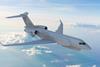












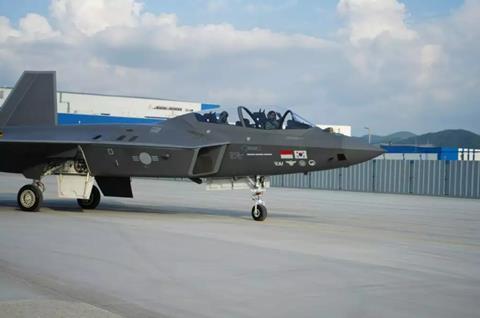
An Indonesian air force test pilot has conducted a sortie in the developmental Korea Aerospace Industries (KAI) KF-21 fighter, signalling that Jakarta remains attached to the type amid its apparent interest in other fighters.
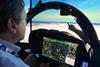
Colonel Mohamad Sugiyanto conducted the flight in the front seat of the fourth KF-21 prototype, according to the Indonesian air force.
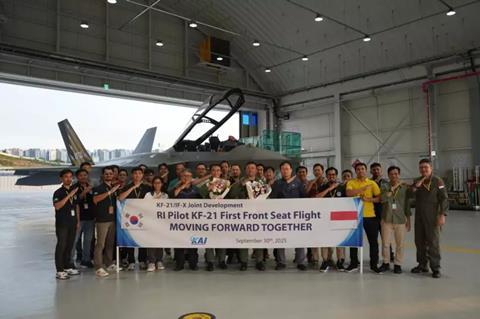
During the 1h mission in South Korea Sugiyanto conducted stability and control tests between altitudes of 10,000-20,000ft, with a KAI test pilot in the back seat.
Sugiyanto had previously become the first non-South Korean pilot to fly in the back seat of the KF-21, in May 2023.
“His success in sitting in the front seat further emphasises Indonesia’s active role in the joint fighter aircraft development programme,” says the Indonesian air force.
“The involvement of Indonesian air force pilots in the flight test phase is part of the implementation of the Indonesia-South Korea cooperation in the KF-21/IF-X project.”
It adds that the KF-21 is a key programme for technology transfer to Indonesia’s aerospace sector. Plans for the KF-21 programme call or the development of two variants: the KF-21 for the Republic of Korea Air Force; and an IF-X variant for the Indonesian air force.
In June, Jakarta and Seoul rebooted their cooperation in the programme after years of squabbling about funding.
The agreement saw Jakarta sharply reduce its financial commitment to the programme. Jakarta was originally to pay W1.7 trillion ($1.2 billion) towards the W8.1 trillion programme, but this was reportedly reduced to W600 billion, of which Jakarta has paid W400 billion.
Apart from cost sharing issues, allegations emerged in 2024 that Indonesian engineers in South Korea had stolen programme data on USB devices, prompting a police investigation.
The engineers were ultimately acquitted and returned home, but South Korea’s Defense Acquisition Program Administration, which is overseeing the KF-21 programme, acknowledged that the incident strained the partnership.
Jakarta’s apparent interest in the KF-21 has not stopped it from considering other fighter options to recapitalise its ageing air force fleet, despite budgetary challenges.
In 2022 it committed to buying 42 Dassault Aviation Rafales, with the first examples to arrive in 2026. In a May 2025 visit to Jakarta, French President Emmanuel Macron said Indonesia was considering a follow-on order for the French type.
In July, Jakarta ordered 48 examples of the Turkish Aerospace Kaan fighter, an aircraft that is still in the very earliest stages of development. The KF-21, by contrast, has been in testing since 2023 and is set to enter South Korean service in 2026.
Jakarta also has expressed interest in the Boeing F-15EX and the Chengdu J-10C.
Indonesia’s involvement in the KF-21 is critically important for Seoul, as it should pave the way for a large international order for the type, which will help offset hefty development costs.
South Korea has already ordered 40 KF-21s in two tranches, with a total commitment likely to be for 120. Earlier plans had called for Indonesia to obtain around 50 jets.
According to FlightGlobal’s 2025 World Air Forces directory, the Indonesian air force’s current combat aircraft fleet includes 25 Lockheed Martin F-16s, 21 BAE Systems Hawk 209s, 16 Sukhoi Su-27/30s, and 13 Embraer EMB-314 Super Tucano light-attack aircraft.