











Allied air forces are conducting major Asia-Pacific airpower exercises during July, with a focus on long-range deployments and interoperability.
Talisman Sabre is a biennial, multinational military exercise led by Australia and the United States. The Talisman Sabre 2025 exercise in northern Australia has seen a number of unique training activities.
A US Air Force (USAF) Boeing RC-135V/W Rivet Joint signals intelligence aircraft joined Talisman Sabre for the first time, with a 55th Wing asset deploying to Australia from Offutt AFB, Nebraska.
The deployment, which took nine months of planning, involves 200 personnel and over 55t of equipment deploying to Australia aboard a pair of Boeing C-17 strategic transports.
Underlining the interoperability between the USAF and the Royal Australian Air Force (RAAF), a pair of USAF pilots flew two RAAF Lockheed Martin F-35As – a first of its kind “interfly” effort.
“In the short term, interfly events like this allow us to exchange information and best practices,” says USAF Reserve Major Justin Lennon, one of the pilots involved in the activity.
“In the long term, as a coalition, normalising interfly gives commanders additional options for agility and versatility in a future conflict. In a prolonged conflict, airplanes are capable of flying more hours a day than a pilot. Having the added flexibility to put any pilot in any F-35 and generate combat airpower anywhere in the world adds to the F-35 coalition’s lethality.”
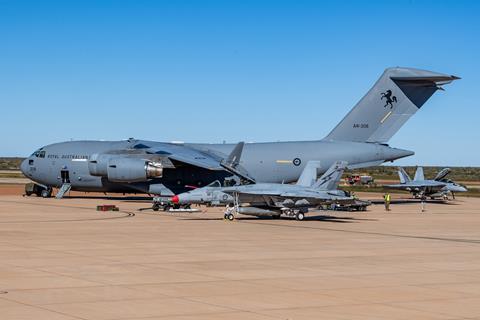
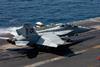
In another Talisman Sabre training effort, RAAF Boeing F/A-18E/F Super Hornets were refuelled and rearmed at a forward arming refuelling point – or FARP – at an austere airfield. This involved an RAAF C-17 unloading refuelling and rearming equipment that was then used to service the fighters.
Early on in Talisman Sabre six C-17s also participated in a night drop of 335 US Army paratroopers, vehicles, and other equipment after a 14.5h flight from Elmendorf-Richardson AFB in Alaska. Joining the US soldiers in the drop were paratroopers from Germany and France.
“We own the night,” says US Army Colonel Brian Weightman of the US Army’s 11th Airborne Division.
“Our ability to fly halfway around the world, communicate in real time, and drop combat-ready troops and equipment into an area should serve as a reminder to any potential adversary.”
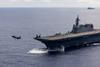
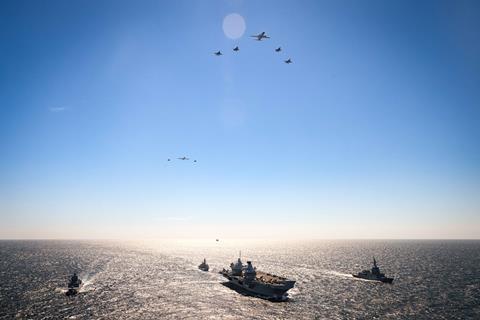
The UK is also participating in Talisman Sabre, dispatching a carrier strike group centered on HMS Prince of Wales, which carries a complement of F-35Bs and helicopters. The Royal Air Force has also sent an Airbus Defence & Space A330 Multi-Role Tanker Transport.
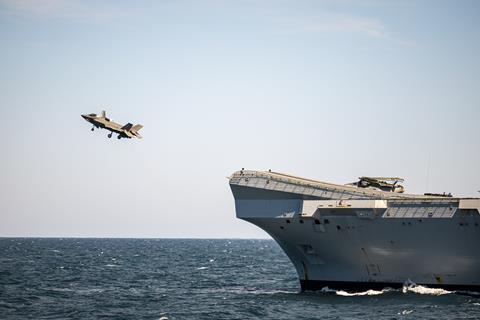
Coincident with Talisman Sabre, the USAF and coalition partners are also conducting the Resolute Force Pacific – or REFORPAC – exercise. This sees the rapid “mass deployment” of aircraft, personnel and equipment to the Asia-Pacific.
REFORPAC, which involves more than 400 US and coalition aircraft, is focused on flightline operations, munitions loading, hot-pit refuelling, combat search and rescue, distributed logistics, and air-to-air refuelling. The scale is vast, involving 12,000 service members at more than 50 locations spanning an area of 3,000 miles.
“The exercise conditions during REFORPAC will require airmen to move fast, fight under attack, and sustain combat operations in ways we haven’t done in decades,” says Pacific Air Forces commander General Kevin Schneider.
“Our ability to fight and prevail in any contested environment depends on our team’s ability to generate aircraft sorties while under attack and often far away from our main operating bases.”
REFORPAC is also testing the USAF’s Agile Combat Employment – or ACE – strategy. ACE aims to complicate the targeting picture for adversaries by deploying combat airpower from a broad range of airfields away from traditional large bases.
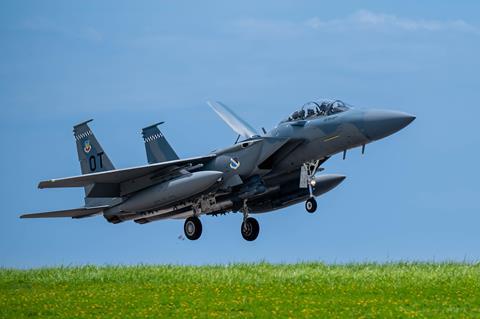
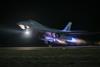
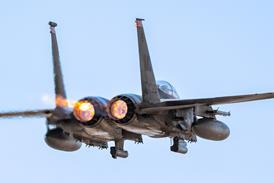
REFORPAC also included a pair of Boeing F-15EX fighters that have been detached to Japan’s Kadena air base. In early 2026 the USAF will deploy 36 of the latest F-15 variants to Kadena.
In another exercise, USAF F-35As deployed to the Philippines for Cope Thunder 25-2, the first time a squadron of the conventional take-off and landing variant of the F-35 has deployed to the Philippines.
The deployment saw the F-35As operate with Korea Aerospace Industries FA-50s operated by the Philippine air force. The F-35As also gained experience operating from an austere location with minimal personnel.
Cope Thunder has been run since 1976 and is intended to improve interoperability through bilateral fighter training and other activities.