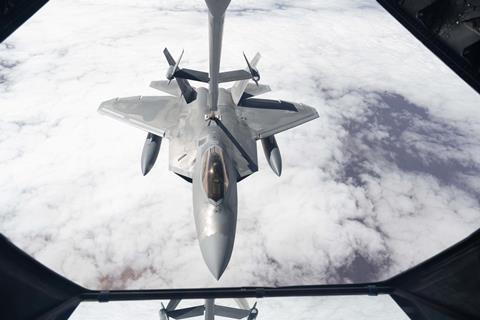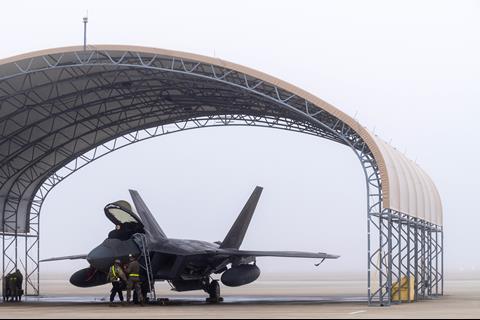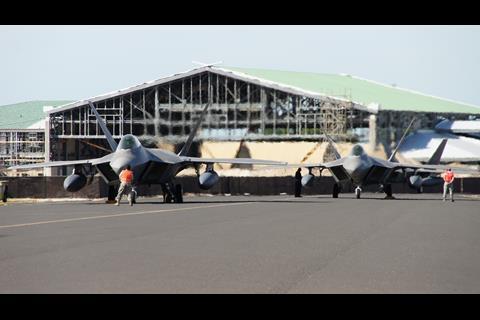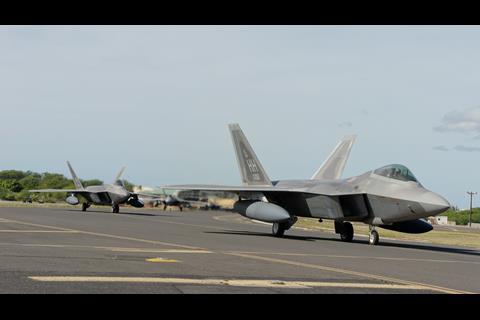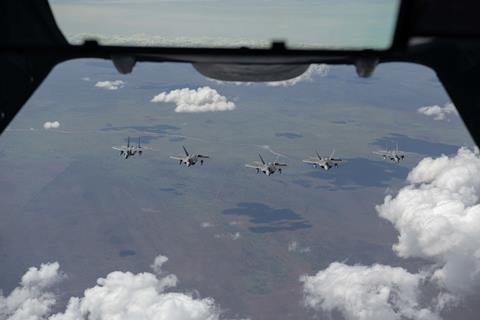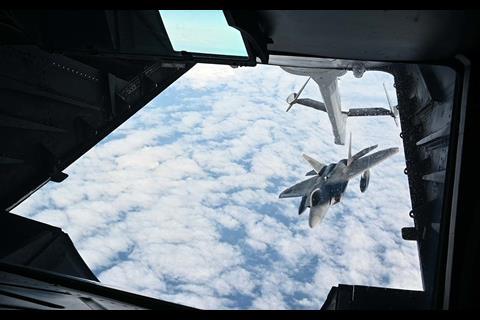















New low-drag external fuel tanks developed by Lockheed Martin will give the company’s F-22 Raptor more range without compromising stealthiness or aerodynamic performance, Lockheed says.
The company tells FlightGlobal it has begun producing the tanks after completing “significant” flight testing. Lockheed had teased the new tanks for several years.
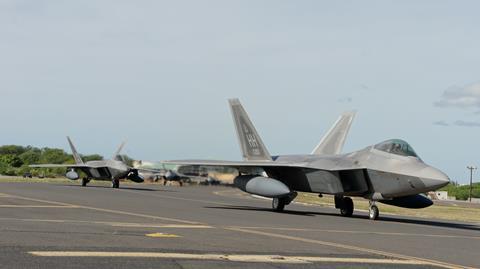
The external reservoirs are meant to replace the F-22’s current wing-mounted “drop tanks”, which offer increased operating radius but significantly impact the stealth jet’s radar signature and ability to perform the aerobatic manoeuvres for which the Raptor is famous.
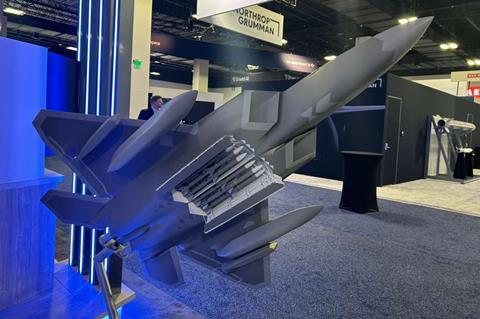
Lockheed displayed a model of the new fuel tanks at the 2026 Air & Space Forces Association Warfare Symposium in Denver, Colorado this week.
While Raptor pilots must discard the current drop tanks to ensure maximum combat performance and survivability, Lockheed tells FlightGlobal the new tanks are designed to stay on-wing, even during combat
“These can go into combat,” says Katie Ciccarino, vice-president of Lockheed’s F-22 programme.
“They are droppable if they need to be,” she adds. “But the idea would be not to drop them, and to retain them throughout whatever the pilot is doing and then coming home and being able to use them again.”
That is a significant departure from the F-22’s current external tanks, which are mainly used to support long-range ferry flights.
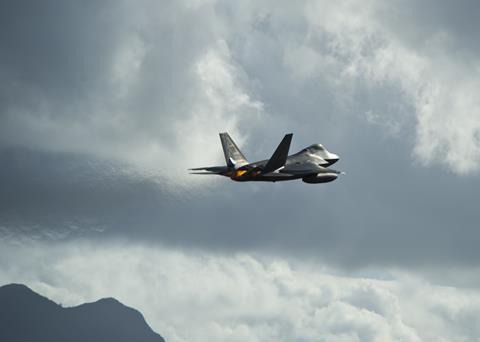
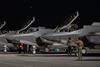
Video circulating on social media shows drop-tank-equipped F-22s departing the US-run base at RAF Lakenheath in the UK – presumably headed to the Middle East as part of Washington’s build-up in the region.
Both the current and new external tanks provide F-22s with an extra 850nm (1,570km) of range, according to Lockheed. Air force figures list the unrefuelled combat radius of F-22s as 590nm.
Lockheed is also developing F-22 wing-mounted sensor pods that it similarly says will not affect the jet’s radar signature or performance. The pod displayed by Lockheed in Denver is mounted outboard of the fuel tanks, which appear in the same positions as the current drop tanks.
Ciccarino says the sensor pods and fuel tanks compose a new “Raptor 2.0” configuration Lockheed is developing for the US Air Force (USAF), which is the sole global operator of F-22s, with 184 in service, according to fleet data provider Cirium.
The USAF must keep its Raptors ready to combat an array of increasingly modern threats, as the service waits for the new sixth-generation Boeing F-47 to come on line.
China is delivering 100-150 fifth-generation Chengdu J-20s annually, according to an open source analysis presented at the Warfare Symposium. The J-20 is billed as China’s answer to the venerable F-22, which entered service in 2005.
Russia is also engaged in limited production of its fifth-generation Sukhoi Su-57, which is Moscow’s response to the F-22.
Pentagon budget documents indicate the Raptor will continue in frontline service until at least the 2040s.
F-22 are to be the first platform in the USAF inventory to be integrated with autonomous Collaborative Combat Aircraft fighters now in development.
Demonstrations earlier this month saw an F-22 control a General Atomics Aeronautical Systems MQ-20 and issue task orders to the uncrewed jet while in flight. Ciccarino says that feat was accomplished using existing hardware aboard the Raptor and an additional cockpit tablet allowing the pilot to interface with the uncrewed aircraft.
Under operational conditions, F-22s typically adhere to strict electromagnetic-spectrum emission controls to preserve stealth. Those restrictions are so stringent that F-22s have traditionally had limited ability to communicate even with friendly aircraft.
Ciccarino says Lockheed and General Atomics established communications between the MQ-20 and F-22 without compromising the latter’s observability signature.
“Everything we do, we want to minimise the impact to the signature,” she says of the F-22 modernisation projects.
Air force budget documents from fiscal year 2026 lay out a plan to increase compatibility between F-22s and the Link 16 data communication system standard on other US and NATO aircraft. Funds from that project are approved to support CCA integration efforts for F-22s.
Lockheed is already under contract with the USAF to deliver the new low-drag fuel tanks for all Block 30/35 aircraft, with the company now standing up a production line, says Ciccarino. “They’ll be rolling out here in the near future.”
Contracts have also been issued for the new sensor pods, which Ciccarino says are still undergoing flight testing.
Block 30/35 aircraft are so-called “combat-coded” F-22s; they have an improved Northrop Grumman APG-77 radar, air-to-ground capabilities, compatibility with additional air-to-air weapons and an added Automatic Ground Collision Avoidance System.
Of the USAF’s 184 F-22s, only around 150 have been upgraded to the Block 30/35 standard for full combat duty. The rest are older Block 20 aircraft used for training and testing. The air force has repeatedly sought to retire the Block 20 jets but has been rebuffed by Congress.
Last year, Lockheed received a separate $270 million contract from the air force to upgrade F-22s with a passive threat-detection system based on the company’s Tactical Infrared Search and Track (TacIRST) system.
That Infrared Defensive System will use a network of sensors embedded in the F-22’s fuselage to identify and track airborne objects via heat signatures.
See photos of the F-22 operating with external fuel tanks: