


















The US government is taking a $1 billion stake in defence manufacturer L3Harris, with the funds targeted at boosting the production of solid rocket motors (SRMs).
Under the terms of the so-called “direct to supplier” partnership, the Pentagon will make the sizeable investment into L3Harris’ Missile Solutions unit – formerly Aerojet Rocketdyne – which will be spun off as a separate operating company. L3Harris will retain a controlling interest in the new business.
As part of the exchange, the US government will receive the equivalent of $1 billion in convertible preferred equity in the new firm, which will deploy those funds toward expanding production capacity for SRMs, which are critical to powering guided missiles and space-based systems.
The Pentagon describes the direct to supplier partnership as the first of its kind. Last August, US commerce secretary Howard Lutnick suggested the Trump Administration was considering taking on partial government ownership of key defence suppliers.
Lawmakers in Congress must approve the deal and authorise funding.
“The terms of the agreement scale up the domestic supply chain for solid rocket motors by providing the upfront investment and stability needed to increase production, modernise facilities, and bolster industrial resilience,” the Pentagon said on 13 January.
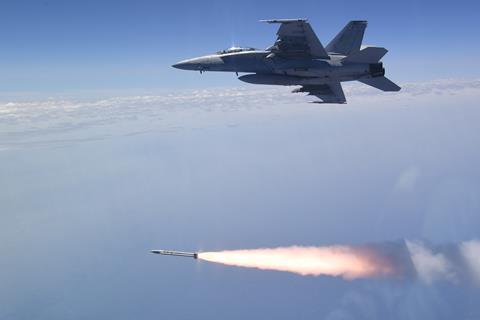
The move is part of a broader shift in procurement strategy the Pentagon is calling “Go Direct to Supplier”, which calls for the US military to directly negotiate with and invest in suppliers deemed to be critical.
The Trump Administration argues this will reduce costs and delivery timelines, while “proactively managing the single points of failure” in the defence supply chain.

L3Harris sits at the nucleus of SRM production in the United States, after the company acquired Aerojet Rocketdyne in 2023, later renaming the company L3Harris Missile Solutions.
At the time Aerojet was the last independent producer of rocket motors in the country.
In 2024, the chief executive of L3Harris said that Aerojet Rocketdyne was delivering some 100,000 SRMs of various types annually, from just one facility in Camden, Arkansas.
Amid an ongoing boom in global demand for long-range, precision weapons, other manufacturers have expanded their capacity for missile propulsion in recent years, including Northrop Grumman, Lockheed Martin and Anduril Industries.
A number of new start-ups have also jumped into market for military propulsion, including Ursa Major and Beehive Industries.
It is highly unusual for the US government to take an equity stake in a defence contractor, although less of an outlier for the Trump Administration. Since taking office in 2025, Trump has directed the government to take partial ownership of US Steel, chipmaker Intel and rare earth elements processor MP Materials.
Last week, Trump also unveiled new measures intended to limit the ability to US defence contractors to issue stock buybacks and dividends if they are underperforming on assigned projects.
The equity research arm of financial giant BNP Paribas describes Washington’s investment in L3Harris as an effort to rebuild the “middle market” of the US defence industry, which has become dominated by a handful of big players after decades of consolidation after the end of the Cold War.
Giving the Pentagon a minority stake in key suppliers could help better align those firms actions with government objectives, according to Tony Bancroft, the portfolio manager of Gabelli Funds’ GCAD aerospace and defence exchange traded fund.
Direct funding from the government reduces short-term pressure to appease shareholders, reduces reliance on volatile private capital and offers upfront liquidity needed to make major investments in new capacity, Bancroft tells FlightGlobal.
”When targeted at strategic gaps, government stakes could meaningfully increase defence industrial base resilience and output, though success depends on clear governance to avoid inefficiency or market distortions,” he says.
An initial public offering for the spun-off L3Harris Missile Systems is planned for the second half of 2026.