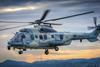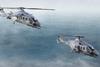














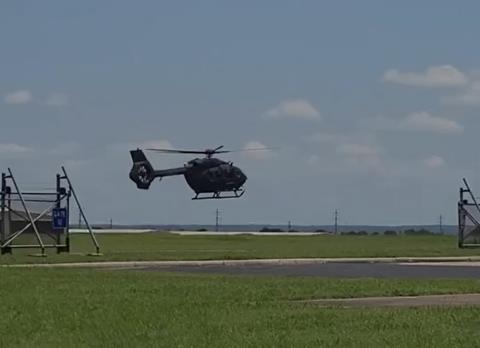
Airbus has completed the first flight of its H145 helicopter incorporating an artificial intelligence agent for autonomous operations.
The airframer revealed the milestone on 19 August, noting the mission was enabled by the integration of Shield AI’s Hivemind autonomy framework.
Taking place in Grand Prairie, Texas in June, the test flight, with a safety pilot aboard, was part of the US Marine Corps’ (USMC’s) Aerial Logistics Connector (ALC) programme, which seeks to deliver an autonomous, uncrewed rotorcraft capable of supporting ship-to-shore logistics by 2029.
Although still early in the development process, Airbus US Space & Defense chief executive Rob Geckle says the company’s forthcoming ALC design “opens the aperture on new mission possibilities” for the USMC.
“We are bringing together the best across industry to deliver an aircraft that changes how unmanned operations can support missions across a wide range of logistics,” Geckle says.
Airbus has been experimenting with uncrewed flights of the H145 since as far back as 2013 using an earlier variant of the light-twin.
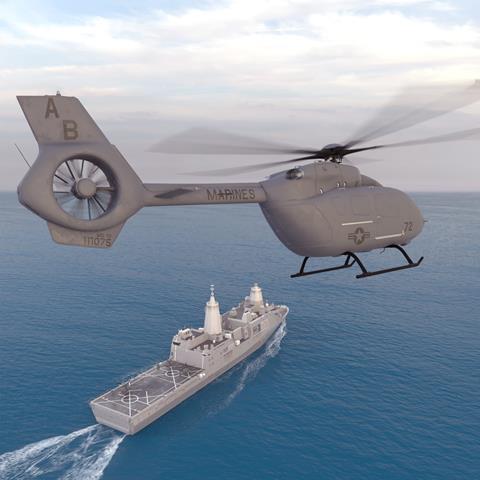
Airbus first announced plans to compete in the ALC programme in 2024, saying it would develop an unmanned variant of the H145-based UH-72 Lakota utility helicopter.
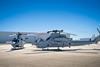
The twin-engined UH-72A serves as the primary trainer helicopter for the US Army, in addition to filling a utility lift role in the Army National Guard (ANG). A small number of newer five-bladed UH-72Bs also perform that mission for the ANG, which is often called on to respond to natural disasters.
Airbus calls the still-developmental uncrewed Lakota the MQ-72C.
Key to converting the H145 from a “UH-” model to an unmanned “MQ-” version is Shield AI’s autonomy software, known as Hivemind.
The company’s artificial intelligence agent is being deployed across the aerospace industry to power autonomous flight. Famously, it is the software behind the Pentagon’s autonomous dogfighting experiment conducted last year that pitted a Hivemind-equipped Lockheed Martin F-16 against human fighter pilots for air combat manoeuvres.
Shield AI said the Hivemind autonomy agent demonstrated the ability to improvise and develop new tactics during those trials.
That software will eventually power the MQ-72C, under a partnership between Airbus and Shield AI announced earlier this year.
“Hivemind was built to enable adaptable, intelligent flight across a wide range of aircraft, and this [H145] milestone shows how quickly capable teams can leverage that foundation,” Shield AI chief executive Gary Steele says.
While the recent test sortie used a standard five-bladed H145, the future MQ-72C design will feature extensive airframe modifications, including replacing the cockpit station with a cargo compartment and adding cargo access doors to the rear and nose of the aircraft.
Airbus has already completed two ALC demonstration events with the USMC and US Naval Air Systems Command to demonstrate the flight performance traits and available cargo space of the H145, with a particular focus on the range needed to operate in the Indo-Pacific region.
Carl Forsling, director of business strategy for Airbus US Space & Defense, tells FlightGlobal the company is bullish on the prospects for completing the process of modifying the H145 airframe and delivering a fully-functional MQ-72C by the specified end date for the ALC programme in 2029.
“We are confident we’ll be able to make a fieldable product by the end of ALC and hopefully be able to segue into either a programme of record or a rapid fielding initiative shortly after the completion of the prototyping effort,” Forsling says.
In addition to proving out the Hivemind autonomy agent, Airbus will also pair it with a new fly-by-wire flight-control system.
While the H145 and UH-72 already offer a high degree of automation to assist crews, Forsling says Shield AI’s Hivemind will vastly expand those capabilities, adding features like in-flight obstacle avoidance and real-time evaluation of landing zone suitability, in addition to autonomous take-offs and landings. Such advances are “far beyond the realm of a normal autopilot”, Forsling notes.
While the USMC programme is currently the company’s main focus for an autonomous UH-72 variant, Forsling says Airbus anticipates the concept will attract interest from other parts of the US military and elsewhere.
“We think that succeeding at the Marine Corps effort is going to be the start of a long iterative process to bring a similar capability to other mission sets, because we really think that this is a significant part of the future of the H145 and Airbus rotorcraft in general,” he says.
That future, Forsling notes, will include multiple design variants offering both optionally piloted and fully autonomous flight profiles.
Competing against Airbus in the ALC effort is Near Earth Autonomy, which has teamed with Honeywell to modify a Leonardo Helicopters AW139.
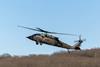
Fellow rotorcraft manufacturer Sikorsky has also entered with its Optionally Piloted Vehicle variant of the UH-60 Black Hawk, which logged its first fully autonomous flight in 2022.
See video of the first autonomous H145 flight featuring Shield AI’s Hivemind: