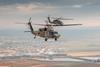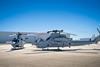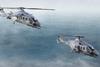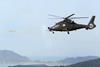














An early naval operator of the Airbus Helicopters H160 has praised the medium-twin for its capabilities as it awaits the arrival of the military M-model variant of the civil platform.
Although France has committed to a 169-unit tri-service acquisition of the H160M Guepard, deliveries, to the army, are not due to commence until 2028, with the navy only receiving its first of 49 aircraft two years later.
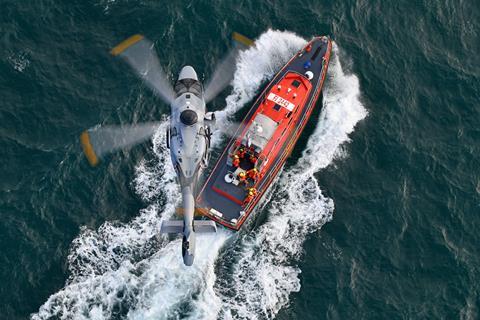
As an interim step, a French naval air squadron has been flying the civil H160 since 2022 for search and rescue missions.
Acquired through a leasing agreement with Babcock, the navy now has six H160s in operation, flown by its flotille 32F from bases in Lanveoc-Poulmic near Brest, Cherbourg – both in the north of the country – and Hyeres on the Mediterranean coast.
Sebastien, the squadron’s commander, says there is “no comparison” between the H160 and the previous-generation helicopters he has flown during his career, including the Airbus Helicopters AS365 Dauphin, Aerospatiale Alouette III, and the Westland Lynx.
“It is safer, with better stability and better [autopilot] protections for pilots, it is really easy to fly this aircraft,” he said during a Singapore air show briefing.
In addition, he highlights the type’s lower fuel burn allowing crews to perform longer-range missions or to “stay on station for a long time”. With rescues of up to 3h not atypical, “the lower fuel consumption is really good for us”, he adds.
Development of the H160M continues following the first prototype’s maiden sortie last July and the second of three prototypes is scheduled to fly in the first half of this year.
Although the third prototype, dedicated to the combined air force and naval variant, will not arrive before 2027, Airbus Helicopters has already begun initial tests related to ship-specific operations.
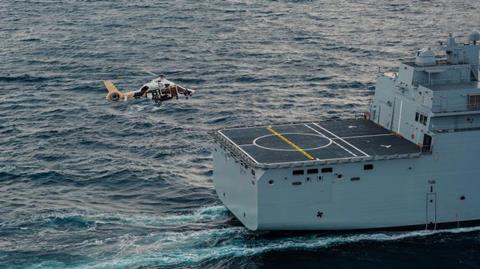
Late last month, France’s DGA defence procurment agency disclosed that on 16 January the initial Guepard prototype made its first approach to a French naval vessel, the supply ship Jacques Stosskopf. Although it did not land, the H160M tested the effects of magnetic interference from the ship’s systems on its sensors.
Xavier Giry, head of operational marketing for naval, maritime security and UAS assets at Airbus Helicopters – and a former French navy helicopter pilot – says the airframer is working closely with its domestic customer to develop the H160M.
He believes the Guepard will benefit from the baseline H160’s civil certification and the “level of maturity” reached by the platform, particularly in areas like maintenance.
However, the H160’s largely smooth service entry was sullied at the start of January by the ditching of an oil and gas-roled example off the Brazilian coast.
A preliminary report from Brazil’s CENIPA accident investigation agency says the pilots were forced to perform the emergency landing after experiencing severe vibrations following the fatigue failure of a pitch-change control rod on the H160’s main rotor.
In the days following the 2 January incident Airbus Helicopters and the European Union Aviation Safety Agency mandated the replacement of pitch link control rod end bearings every 165 flight hours.
Although deferring questions on the ongoing investigation to the authorities, Thomas Zeman, Airbus Helicopters’ head of sales and marketing for the Asia-Pacific, says the “preliminary measures” introduced by the airframer “in coordination with the authorities” had generated a positive reaction from operators.
“They have praised us for our transparency,” he says, and “the speed at which we have been able to collaborate with the authorities and keep [them] informed”.