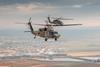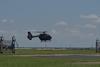












The Sikorsky VH-92A helicopter appears poised to play a growing role in the transport of the US president as the helicopters it will replace approach retirement.
According to the US Marine Corps’ (USMC’s) 2026 Aviation Plan, the long-serving Sikorsky VH-3D will remain in operation through 2026, with the Sikorsky VH-60N to continue operating through 2030.
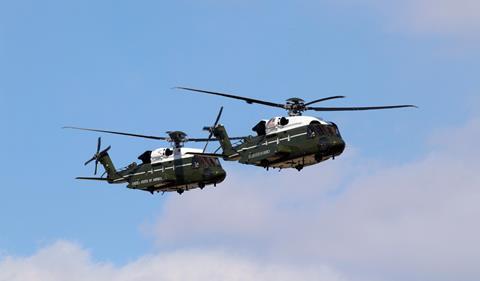
“HMX-1 is currently executing a planned transition from the legacy VH-3D and VH-60N aircraft to the VH-92A,” says the USMC document.
“The US Marine Corps achieved initial operational capability for the VH-92A in December 2021, and HMX-1 commenced operational missions with the new aircraft in 2022.”
HMX-1 operates 10 VH-92As. The USMC accepted its 23rd, and final, example in August 2024. When the VH-3D and VH-60N are retired, HMX-1’s fleet of VH-92As will grow to 16 rotorcraft, operating as ‘Marine One’ when the US president is embarked.
Improvement work for the VH-92A is focused on enhancing high-altitude, high-temperature performance and expanding available bandwidth through the integration of beyond-line-of-sight communications systems.
The USMC plan makes no mention of a key issue that challenged the early adoption of the VH-92A: the scorching of the White House lawn by the type’s GE Aerospace CT7-8A6 turboshafts and its auxiliary power unit.
The USMC is also working on the reliability and safety of the Bell-Boeing MV-22 Osprey, specifically improvements to the tiltrotor’s proprotor gearbox and drive system.
Fielding of a redesigned input quill assembly is expected to begin in 2028. This addresses hard clutch engagement events, in which the clutch slips and violently re-engages, creating torque spikes that damage the drive system and cause a loss of control.
The USMC also continues to transition its heavy-lift capabilities, with the Sikorsky CH-53K to fully replace the CH-53E by 2032.
Some 200 CH-53Ks will be obtained and the new type will make its first operational deployment in the 2027 financial year, which runs from 1 October 2026 to 30 September 2027.
The USMC also sees Bell H-1-series helicopters continuing to play a key role in Marine Light Attack Helicopter squadrons.
“The AH-1Z Viper and UH-1Y Venom provide attack and utility capability, working in concert with the naval and joint force, to sense, shoot, survive, and sustain inside the weapon engagement zone,” says the USMC plan.
“As a kill web enabler and effector, H-1s expand depth, range, and communication to the [Marine Air Ground Task Force], providing lethal and non-lethal options to the commander. H-1s are essential to narrowing service gaps in low-altitude attack, strike, and utility capabilities, and will continue flying into the 2040s.”