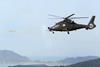














Augmented-reality start-up Red 6 has for the first time equipped a rotorcraft with its technology.
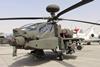
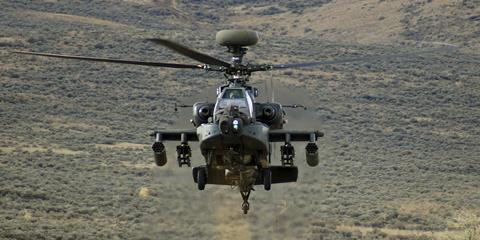
The company on 17 November said it has integrated its Advanced Tactical Augmented Reality Systems (ATARS) technology into the cockpit of Boeing’s AH-64E Apache Crewstation Advanced Technology Testbed – which Boeing describes as an advanced simulation system used to develop new features and test new features for the attack helicopter.
Boeing is currently engaged in a wide-ranging modernisation effort for the AH-64E meant to incorporate capabilities such as increased automation and the ability to work with uncrewed assets.
The ATARS integration milestone marks both Red 6’s first foray into rotary-wing aviation and the company’s first concrete strides toward a business deal with the world’s largest helicopter operator – the US Army.
“Exploring the integration of ATARS with the Apache marks a significant milestone, not only as our inaugural collaboration with a rotorcraft platform but also as our first potential partnership with a US Army platform,” says Daniel Robinson, chief executive of Red 6.
“This collaboration demonstrates the versatility and strategic value of augmented reality training across all domains of military aviation,” he adds.
Red 6’s ATARS is a helmet-mounted system that can project simulated imagery directly onto a pilot’s visor while flying a physical aircraft.
In practise, this allows new and seasoned aviators to drill on complex tasks like aerial refuelling, approaching an aircraft carrier for landing or performing aerial combat manoeuvres – without the cost and risk of live training.
ATARS records flight data from training scenarios, which Red 6 says operators can use to objectively and accurately measure readiness.
Boeing says the technology will assist air crews in drilling on near-peer-level threat scenarios and help test the integration of uncrewed rotorcraft into conventional army flight operations.
“Augmented reality technologies such as ATARS open up new opportunities to prepare military aviators for complex threat environments they face today and will encounter in the future,” says Kathleen Jolivette, general manager of Boeing’s vertical lift division.
At the Paris air show in June, Red 6 told FlightGlobal it plans to use augmented reality to help rotary-wing aviators practise take-offs and landings in degraded visual conditions like rotorwash brownout.
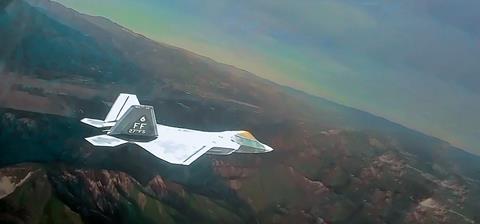
Until now, the company’s focus has been primarily on fixed-wing jets, with existing agreements to install ATARS in a number of platforms, including the Northrop T-38C, Boeing T-7A and Leonardo M-346 trainers.
The company is also working to install individual ATARS demonstrators into other platforms operated by the US Air Force, including Lockheed Martin’s F-16, F-22 and F-35 jets.
In 2024, Red 6 completed ATARS demonstration flights with the UK Royal Air Force to assess the viability of augmented reality aboard the service’s BAE Systems Hawk T2 trainers.
Rate production on ATARS is projected to begin sometime in 2026.